
Complete sludge handling from thickening through dewatering to disposal. Reduce sludge volume, minimise disposal requirements, and recover resources from the by-product of every wastewater treatment process.
Groundwater treatment for tunnel dewatering operations. Remove suspended solids, adjust pH and manage contaminated water.
Dewatering Systems by Reynolds & Bauhm. Industrial water and wastewater treatment solutions engineered for efficiency, durability.
Dewatering water treatment for pits, tunnels and underground mines.
Complete sludge handling solutions. Thickening, dewatering, drying and disposal preparation for wastewater treatment plants.
Minimising sludge volume and disposal requirement through efficient dewatering
Sludge is the unavoidable by-product of wastewater treatment, but its management need not be a burden. Effective thickening and dewatering reduce volume by up to 90%, dramatically cutting transport and disposal requirements. Reynolds & Bauhm engineers each sludge handling stage to match your sludge type, volume, available space, and disposal route, delivering a system that operates reliably with minimal operator attention.
Gravity belt thickeners and drum thickeners concentrate dilute sludge from 1-3% to 4-8% solids before dewatering, reducing downstream equipment sizing and chemical consumption.
Belt presses, screw presses, and centrifuges mechanically remove water from thickened sludge to produce a stackable cake suitable for landfill, incineration, or agricultural use.
Dewatered cake can be disposed to landfill, applied to agricultural land as a soil amendment, or processed through drying and incineration for volume reduction and energy recovery.
Belt presses, screw presses, and centrifuges for every application
Continuous gravity and pressure belt filtration for municipal and industrial sludges. Open design allows visual monitoring of the dewatering process. Stainless steel construction with automated belt tracking and wash systems for reliable operation.
View Belt PressesLow-speed, low-energy screw presses with automatic self-cleaning screens. Enclosed design contains odours and prevents splashing. Minimal washwater requirement and low operating speed reduce wear and maintenance.
View Screw PressesHigh-speed horizontal scroll centrifuges for continuous sludge dewatering. Achieve very high solids content in cake and low polymer consumption. Fully enclosed operation with minimal odour and noise emission.
View CentrifugesLow-energy multi-disc screw press using a series of overlapping stainless steel discs to progressively dewater sludge. No washwater required, minimal power consumption, and very quiet enclosed operation.
View Multi-Disc PressRecessed chamber and membrane filter presses producing very high solids cakes up to 40% dry solids. Batch operation with high-pressure squeeze for challenging sludges where maximum dryness is required.
View Filter PressesContinuous gravity thickening on a porous belt for dilute sludges from biological processes. Simple, reliable operation with no moving parts in contact with sludge. Concentrate from 1% to 4-6% solids before dewatering.
View ThickenersEffective dewatering depends on proper sludge conditioning. Reynolds & Bauhm designs polymer preparation and dosing systems that achieve optimal flocculation with minimal chemical consumption, reducing operating overheads and improving cake quality.
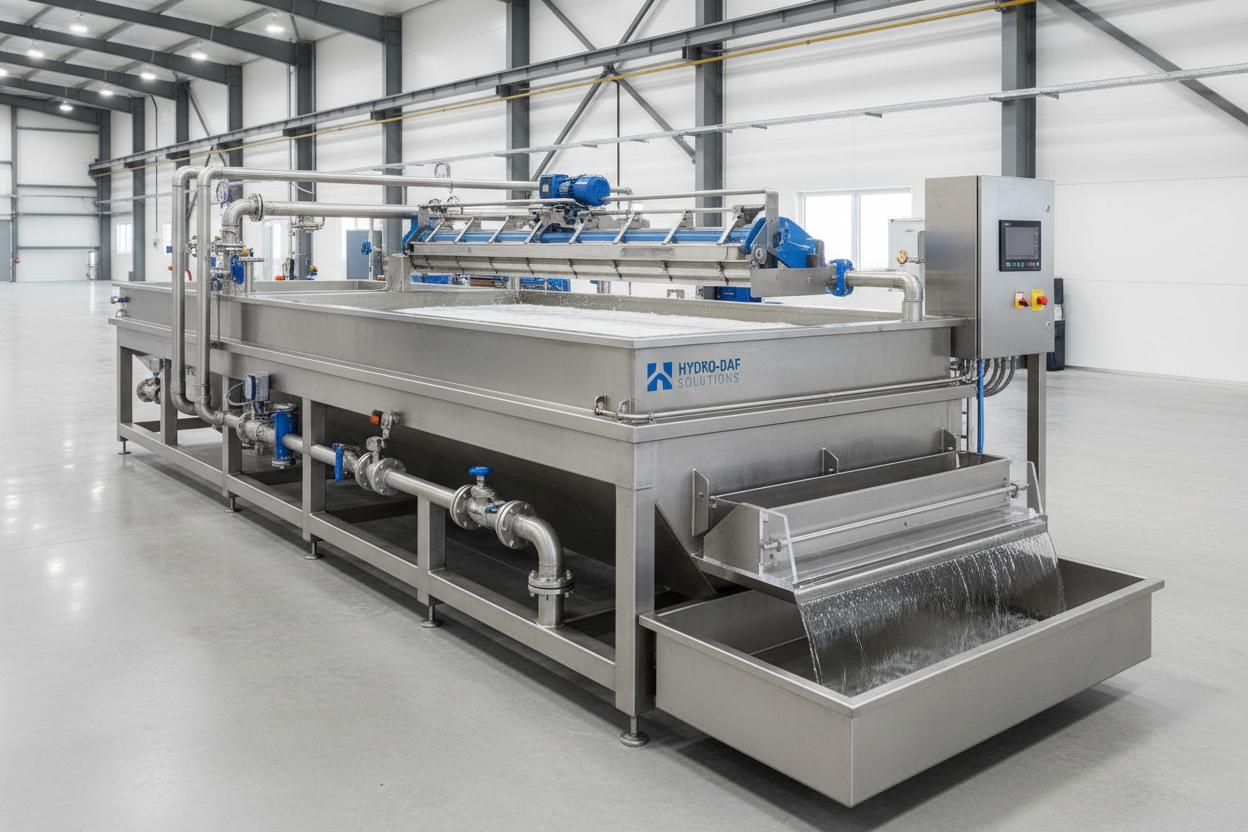
Selecting the right equipment for your sludge type and volume
| Equipment | Typical Cake Dryness | Power Demand | Washwater | Best For |
|---|---|---|---|---|
| Belt Press | 18 - 24% DS | Low | Moderate | Municipal, general industrial |
| Screw Press | 18 - 22% DS | Very Low | Minimal | Small-medium volumes, low energy |
| Decanter Centrifuge | 20 - 30% DS | High | None | High throughput, minimal footprint |
| Multi-Disc Press | 18 - 25% DS | Very Low | None | Odour-sensitive installations |
| Filter Press | 35 - 45% DS | Moderate | None | Maximum dryness, batch operation |
| Gravity Belt Thickener | 4 - 8% DS | Low | Low | Pre-thickening before dewatering |
Cake dryness and performance depend on sludge type, conditioning, and operating parameters. Pilot testing recommended for accurate selection.
Bound water, EPS and the cake-filtration physics that govern every dewatering line
Sludge is not a Newtonian fluid. It is a structured suspension of microbial flocs and inorganic particles held together by extracellular polymeric substances (EPS), with water present in four distinct forms: free water (drains under gravity), interstitial water (released by mild pressure), surface-bound water (released only under high shear or compression) and chemically-bound water (only thermal drying releases it). Mechanical dewatering targets the first three; their relative proportions, set by sludge type and SRT, ultimately limit the achievable cake DS.
| Sludge Source | Feed DS (%) | VS/TS | SRF α (m/kg) | Compressibility s | Notes |
|---|---|---|---|---|---|
| Primary (municipal) | 2–6 | 0.65–0.75 | 1011–1012 | 0.3–0.5 | Easiest to dewater; fibrous, low EPS |
| Waste activated (WAS) | 0.5–1.5 | 0.70–0.85 | 1013–1015 | 0.7–1.0 | High EPS; gelatinous; needs ≥5 g/kg polymer |
| Anaerobically digested | 2–4 | 0.55–0.65 | 1012–1013 | 0.5–0.8 | Lower viscosity than WAS; pathogen-reduced |
| Chemical / physico-chem | 1–4 | 0.30–0.50 | 1011–1012 | 0.2–0.4 | Inorganic flocs (Al/Fe); good filterability |
| DAF float (food/dairy) | 3–6 | 0.85–0.95 | 1012–1013 | 0.6–0.9 | FOG-rich; warm conditioning improves release |
SRF (specific resistance to filtration) is measured by Buchner funnel test; the time-to-filter (TTF) and capillary suction time (CST, range 5–30 s after conditioning) are the routine field equivalents used to fix polymer dose.
| Throughput per unit | 10 – 5,000 kg DS/h (single press); larger lines run multiple units in parallel |
| Cake dry solids | Belt 18–24% · Screw/disc 18–25% · Centrifuge 22–32% · Filter press 30–45% |
| Polymer dose | 3 – 10 g active/kg DS (cationic, 30–100% charge density) |
| Solids capture | 92 – 99% (centrate/filtrate < 500 mg/L TSS) |
| Hydraulic loading | Gravity belt thickener 200–400 L/(m·min); decanter 5–25 m³/h |
| Specific energy | Screw/disc press 30–60 Wh/kg DS · Belt 50–100 Wh/kg DS · Centrifuge 200–400 Wh/kg DS |
| Operating pressure | Belt tension 5–8 N/mm · Centrifuge bowl 2,500–3,500 g · Filter press 10–16 bar |
| Wash-water demand | Belt press 4–8 m³/h · Screw/disc press < 0.5 m³/h · Centrifuge none |
| Materials | SS304 standard; SS316L for halide-rich industrial sludges; duplex for desalination brine sludge |
Mechanical dewatering returns 20–40% of the feed nitrogen and 10–30% of the phosphorus back to the head of works as concentrated reject. Centrate from anaerobic digestate can carry 500–1,500 mg/L NH4-N and contribute 15–25% of the total plant N-load — routing it un-throttled to the activated sludge tank during peak hours causes nitrification crashes. We size sludge lines as part of the whole-plant nitrogen balance and, where the load justifies it, propose dedicated side-stream treatment (deammonification / SHARON-anammox at 20–40 °C) for 80–90% reject-N removal at a fraction of mainline aeration cost.
Concentrating 1% WAS to 5% before dewatering reduces downstream equipment volume 5× and polymer dose 30–40%.
Filtrate is buffered and trickle-fed back to primary clarifier or pre-anoxic zone to flatten the diurnal nitrogen spike.
Struvite (MgNH4PO4·6H2O) crystallisation on the reject stream recovers 80–90% of P as fertiliser-grade product.
Our process engineers will analyse your sludge characteristics, disposal requirements, and operational constraints to recommend the most efficient thickening and dewatering solution.
Plan and elevation drawings for sludge transfer, thickener underflow, and dewatering feed lines.
View ServiceBelt press, centrifuge, and tank GA drawings with access and maintenance zones.
View Service3D routing for polymer dosing and sludge conveyance with clash-free installation.
View ServiceProcess diagrams showing sludge conditioning, dewatering, and cake discharge sequences.
View ServiceGravity, DAF, and drum thickening to raise DS from <1% to 5–8% before dewatering.
View guide →Mesophilic and thermophilic digestion for volatile-solids destruction and biogas generation.
View guide →Land application, composting, lime stabilisation, and thermal pathways for treated sludge.
View guide →Belt, drum, and fluidised-bed dryers to achieve >90% DS for pelletisation or energy recovery.
View guide →Choose the right dewatering technology with our full equipment comparison guide.
Compare equipment →Our expertise spans multiple industries with sector-specific water treatment solutions.
Send your influent analysis and our engineers assess your process and recommend a tailored treatment solution — free, confidential and no obligation.
Select the regulatory standard for your country — it sets which parameters we need for a compliance-aware process assessment.
Required parameters for the chosen standard are flagged on the sample form. You can still submit a partial set and we will advise what else to test.
Your sample is stored against your company so we can track the project. Provide a company name or email as a minimum.