
Reynolds & Bauhm designs and builds complete water treatment systems for university research centres. Influent preparation, reaction vessels, separation stages, and effluent monitoring integrated into one research-optimised facility.
A world-class research centre needs more than individual pilot rigs. It needs an integrated treatment platform where every stage is instrumented, every sample point is accessible, and every process variable is controllable from a single supervisory system.
Reynolds & Bauhm designs, builds, and commissions complete research facility water treatment systems for UK universities. From raw water or wastewater influent through to final effluent, every vessel, every pump, every sensor, and every sampling port is positioned to serve your research programme, not a standard product line.
Multiple treatment stages designed as one hydraulic and control system. Residence times, recirculation rates, and inter-stage buffering calculated for your experimental matrix.
All instrumentation connected to a single data historian. Time-synchronised data from every stage of treatment available for your statistical analysis and model validation.
By-pass lines, interchangeable reactor vessels, and modular separation stages let you reconfigure the treatment train between research programmes without major plant modification.
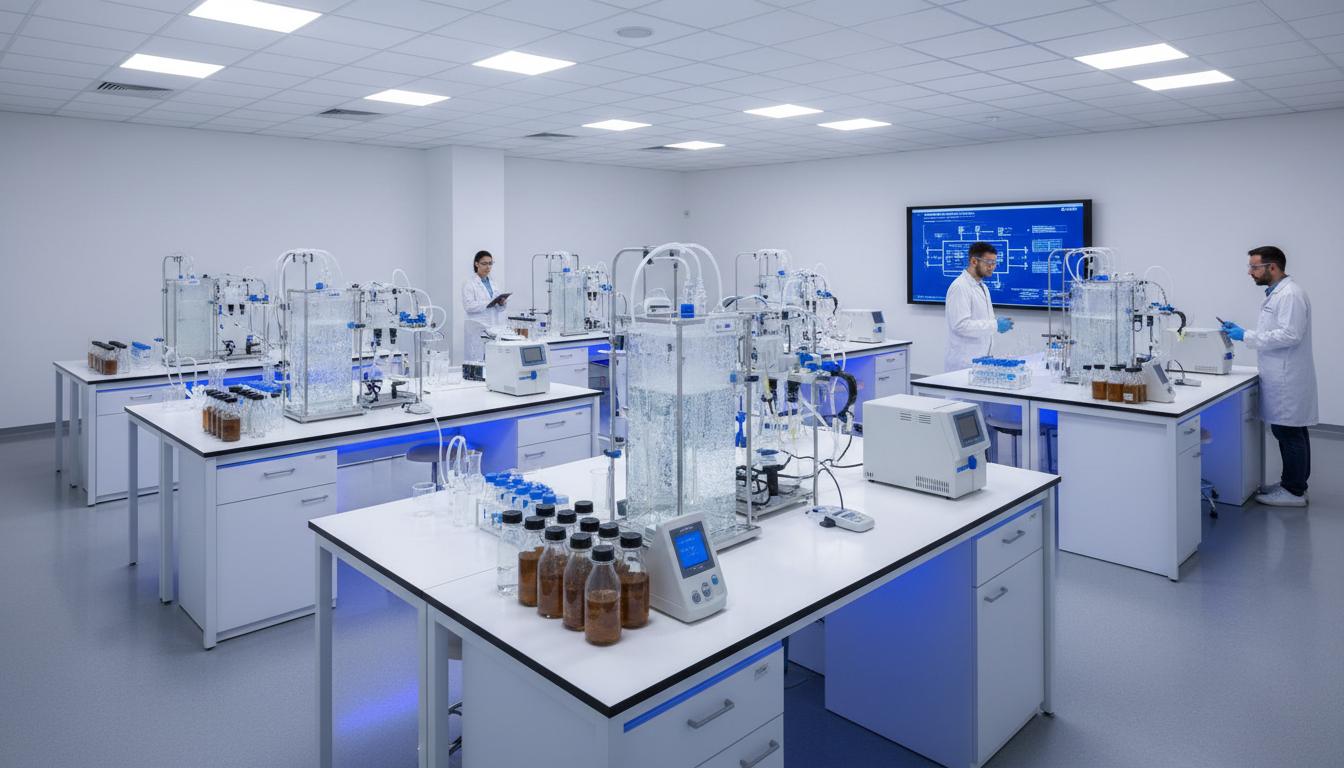
Every research facility we build is unique. These are the standard modules we integrate to create your bespoke research platform.
Raw water or wastewater conditioning including flow equalisation, temperature control, pH adjustment, and synthetic dosing for controlled challenge studies. Designed to deliver consistent influent quality to your experimental protocol.
Multiple reactor vessels configured for your research programme. Chemical reaction, biological treatment, or advanced oxidation, each with independent control of residence time, mixing intensity, temperature, and reagent dosing.
Clarifiers, dissolved air flotation units, membrane housings, and filtration skids designed to separate your reaction products with the efficiency your mass balance requires. Instrumented for real-time performance verification.
Automated and manual sampling points at every process stage. Quick-connect fittings for portable analysers, bypass lines for online instrumentation, and sample preservation systems for off-site laboratory analysis.
Supervisory control with real-time trending, alarm management, and automated data export. Compatible with your existing laboratory data systems. Full audit trail for research integrity compliance.
Secondary containment, emergency shut-off systems, ventilation control, and spill management designed to your institution's health and safety standards. Full COSHH and risk assessment documentation.
We work with your research team to understand your experimental matrix, performance targets, and instrumentation needs.
Complete process design including P&ID, hydraulic calculations, control philosophy, and instrumentation specification.
Fabrication in our UK facility with full material traceability, weld inspection, and hydrostatic testing.
Installation at your facility with connection to building services, control system programming, and operator training.
Commissioning tests against your research protocol to verify that every stage performs to the specification your experiments require.
Full design basis, hydraulic calculations, mass balances, and performance predictions traceable to your research parameters.
P&ID, general arrangement, electrical schematics, and control system architecture drawings for your facilities team.
Pressure equipment certification, electrical compliance, COSHH assessments, and health and safety file for your safety office.
Operator training for technical staff and research students. O&M manual, calibration procedures, and troubleshooting guide.
This treatment stage is engineered to achieve specific contaminant removal targets while providing stable, predictable performance across variable inlet conditions. Design parameters are calculated from wastewater characterisation data, regulatory requirements, and site-specific constraints including footprint, energy availability, and operator capability.
Design validated by CFD modelling and pilot testing to confirm performance guarantees.
Equipment selected for 20-year design life with minimal wearing parts and easy access.
Automated dosing and feedback control minimise reagent consumption and sludge production.
Online monitoring and data logging demonstrate continuous consent compliance.
| Design Flow | 10 – 5,000 m³/h (application specific) |
| Inlet Variability | Designed for 1:3 peak-to-average flow ratio |
| Removal Efficiency | 85 – 99% depending on target contaminant |
| Hydraulic Retention | Calculated from kinetic constants and safety factors |
| Power Consumption | 0.5 – 5.0 kWh/100 m³ (process dependent) |
| Chemical Dose | Auto-controlled based on online analysers |
| Sludge Production | 0.2 – 1.5 kg DS/kg contaminant removed |
| Materials | SS304, SS316L, or carbon steel with coating |
No treatment stage operates in isolation. This process is designed to receive conditioned influent from upstream stages and deliver effluent quality suitable for downstream processes. Hydraulic and organic loading rates are balanced across the complete treatment train to prevent bottlenecking and ensure overall plant efficiency. Our engineers model the complete flowsheet to optimise Capital expenditure and Operating expenditure across the plant lifecycle.
Screening, equalisation, and pre-treatment protect this stage from damage and overload.
Effluent quality ensures downstream biology, filtration, or disinfection performs optimally.
Reject streams, filtrate, and centrate are routed back to appropriate upstream points.
Contact our engineering team to discuss your research centre requirements. We will develop an integrated facility design that supports your current research programme and adapts to the programmes of the future.
Our expertise spans multiple industries with sector-specific water treatment solutions.