
Equipment engineered to your exact specification. Not assembled from standard units, but designed from first principles, calculated through chemical engineering science, and fabricated with precision by engineers who understand that every inch of your treatment plant must perform.
Custom automation and SCADA integration for critical water treatment processes plants.
Seamlessly integrate new water treatment equipment with your existing infrastructure.
Complete turnkey water treatment plants from initial concept through commissioning.
Comprehensive support packages including preventive maintenance, remote diagnostics, operator training and genuine spare parts.
Why bespoke manufacturing outperforms standard assembly
Most water treatment equipment is assembled from standard catalogue units. A DAF unit here, a screen there, a pump between them. The result works, but it is compromise dressed as solution. At Reynolds & Bauhm, we do not assemble. We engineer. Every vessel is sized from hydraulic calculations. Every plate spacing is optimised through CFD. Every material grade is selected from corrosion data. Every control system is programmed to your specific process parameters. This is the difference between equipment that operates and equipment that excels.
The six pillars of precision manufacturing
Dedicated R&D laboratory with pilot testing rigs, treatability study capability, and full analytical instrumentation. We validate every design hypothesis against real effluent before committing to fabrication.
Explore R&D LaboratoryMass balance modelling, reaction kinetics, stoichiometric analysis, and equilibrium calculations. Every vessel volume, plate spacing, and retention time is derived from first-principles engineering science.
Explore CalculationsComputational fluid dynamics for hydraulic optimisation, bubble distribution analysis, and velocity profiling. Eliminate dead zones, short-circuiting, and uneven flow distribution before steel is cut.
Explore CFD EngineeringStainless steel, duplex, and exotic alloy fabrication with CNC machining, robotic welding, and precision finishing. Tolerances held to engineering drawing specifications, not construction-site approximation.
Explore FabricationHydrostatic testing, weld inspection, surface finish verification, and performance validation against design specifications. Every unit is proven before it leaves our facility, not after it arrives at yours.
Explore QA & TestingMaterials selection from chemical compatibility databases, corrosion rate analysis, and accelerated life testing. The right material for your chemical environment, not the one in stock.
Explore MaterialsPrecision is not an aesthetic choice. It is an engineering necessity. A clarifier plate angle off by two degrees changes settling efficiency. A DAF air dissolution rate mis-calculated by 10% doubles polymer consumption. A material wall thickness underspecified by a millimetre reduces vessel life by years. We calculate every dimension, every flow, every stress, every chemical reaction.
CNC-machined components held to 0.1 mm tolerances. Vessel geometry verified against CFD predictions before fabrication begins.
Flow profiles calculated for laminar, transitional, and turbulent regimes. Velocities verified to prevent floc shear and maintain settling.
Dosing rates calculated from reaction stoichiometry and equilibrium constants. Not rule-of-thumb, but chemical law.
Pressure vessel design to ASME and EN standards. Weld procedures qualified, stress-relieved, and hydrotested to design pressure plus safety factor.
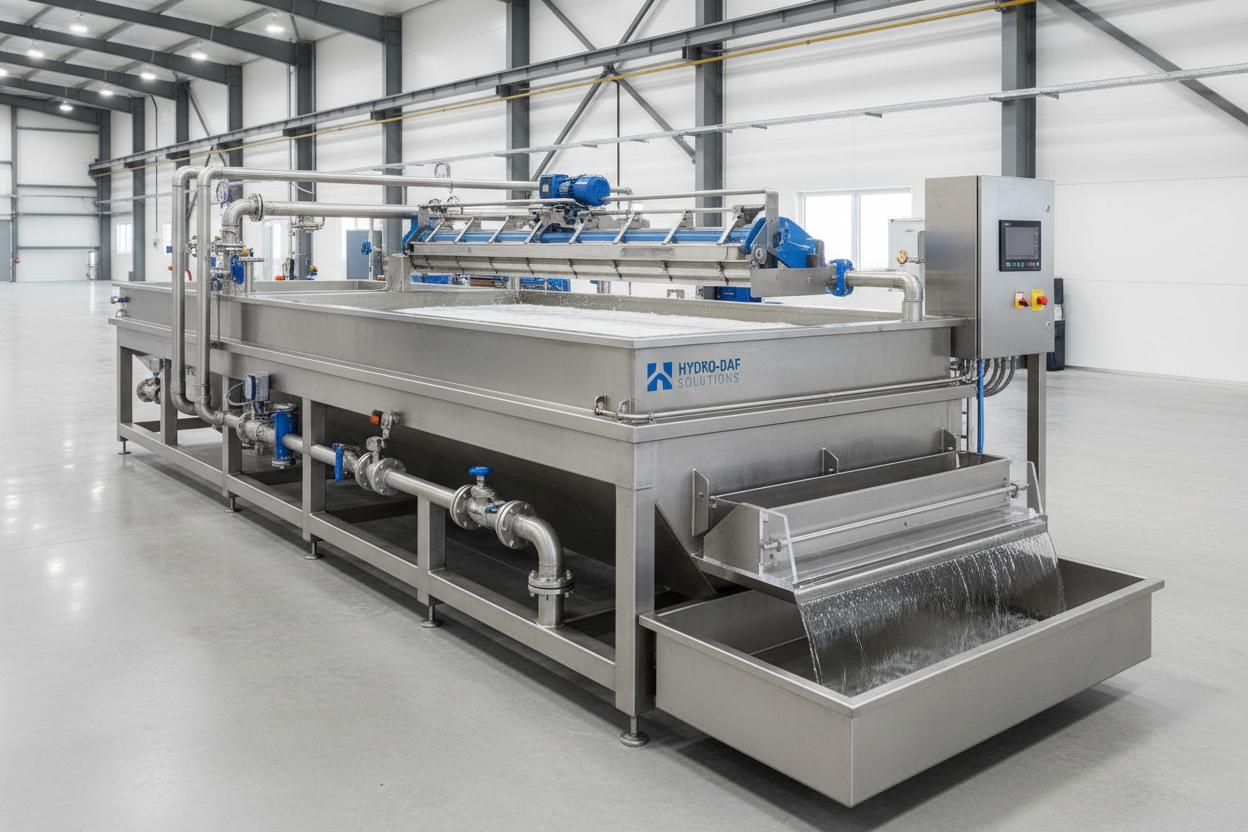
Quality systems that deliver repeatable, traceable, certifiable equipment
All welding is performed to qualified procedures per EN ISO 15614-1 (steel) and EN ISO 15614-11 (titanium). Welders hold current certifications to EN ISO 9606-1. Key parameters controlled:
| Method | Standard | Acceptance Level | Application |
|---|---|---|---|
| Radiographic (RT) | EN ISO 17636-1 | Class B, Quality 2 | Full-penetration butt welds >10 mm |
| Ultrasonic (UT) | EN ISO 17640 | Level 2 (3 mm FBH) | Thick-section welds, forgings |
| Penetrant (PT) | EN ISO 3452-1 | Level 2 | Stainless steel surface defects |
| Magnetic (MT) | EN ISO 9934-1 | Level 2 | Ferromagnetic welds and castings |
| Visual (VT) | EN ISO 17637 | Level 2 | All welds, 100% coverage |
| Leak (LT) | EN 1779 | No detectable leak | Pressure vessels, seal welds |
Surface finish is specified by Ra (arithmetical mean roughness) per ISO 4287. Standard industrial vessels: Ra ≤ 3.2 μm (roughness grade N8). Food-grade and pharmaceutical applications: Ra ≤ 0.8 μm (N6) with electropolishing to 0.4 μm for biofilm prevention. After fabrication, all stainless steel vessels undergo pickling and passivation per ASTM A380 / A967 to restore the chromium oxide layer damaged by welding. The passivation bath is 20–25% nitric acid at 50–60 °C for 30–60 minutes, followed by thorough deionised water rinsing and drying. A ferroxyl test (ASTM A967) confirms passivation completeness — no blue spots within 30 seconds.
Every project has a project-specific ITP defining hold points (H), witness points (W), and review points (R). Client or third-party inspectors are notified 72 hours in advance of hold points. Typical hold points: material receipt inspection, weld procedure qualification, hydrostatic test, final visual inspection, and packing/release.
Pressure vessels are hydrotested at 1.43× design pressure (PED) or 1.3× MAWP (ASME) for 30 minutes minimum. Test fluid is potable water with chloride content <50 mg/L to prevent pitting of stainless steel. Pneumatic testing at 1.1× design pressure is only performed where hydrotest is impractical, with blast-area clearance per ASME VIII UG-100.
Mill test certificates to EN 10204 3.1 (manufacturer's test) or 3.2 (manufacturer + independent inspector verification) are provided for all pressure-retaining materials. Heat numbers are stamped or etched on each plate and forging, with weld maps linking every joint to the welder, WPS, and NDT report.
Critical machined dimensions are held to ISO 2768-f (fine) or ISO 2768-m (medium) as specified. Shaft bearing journals: h6 tolerance. Bore fits: H7. Flatness of sealing faces: 0.01 mm over diameter. Surface finish of dynamic seals: Ra 0.4–0.8 μm. CMM inspection reports accompany all precision-machined components.
Every water treatment challenge is unique. Our bespoke engineering team designs, fabricates, and commissions custom equipment and systems that standard products cannot address. From exotic material selection to extreme duty specifications, space-constrained layouts, and integration with legacy control systems, we deliver solutions that work in your specific operational context.
3D CAD modelling and CFD simulation validate performance before fabrication commences.
SS304, SS316L, duplex, and exotic alloy welding and machining in our European workshops.
Control systems communicate with your existing SCADA, DCS, and PLC infrastructure.
Complete design dossier, HAZOP, FAT/SAT protocols, and O&M manuals provided.
Site survey, water analysis, and process requirement definition with your engineers.
Process flow diagram, P&ID, and 3D layout with performance guarantees and budget estimate.
Mechanical, electrical, and control design with material specifications and vendor selection.
Workshop construction with QA/QC inspection, weld records, and pressure testing.
Logistics, cranage, mechanical installation, and pipework connection by our teams.
FAT, SAT, performance trials, operator training, and handover documentation.
Standard corrosion-resistant stainless for municipal, food, and general industrial applications.
Superior chloride resistance for marine, offshore, and high-salinity process waters.
Maximum corrosion resistance for extreme chloride, sour gas, and high-temperature duties.
Hastelloy, Inconel, and titanium for aggressive chemistries and ultra-high purity requirements.
Packaged, containerised, skid-mounted and research-station families engineered for sites with no road, no grid, no operator and no local supply chain.
All five product families plus the engineering choices that span the catalogue — transport envelopes, off-grid power, satellite SCADA, swap-on-failure spares.
Read the HubComplete plants delivered as a single pre-commissioned package — villages, mining camps, expedition bases.
Read More10′, 20′ and 40′ ISO container plants hardened for hurricane, arctic, desert and salt-air environments.
Read MoreModular skids sized to helicopter sling-loads, 4×4 trailers and ATV sleds for sites with no road access.
Read MoreSpeak with our engineering team to discuss your specific wastewater challenge. We will analyse your effluent, calculate the optimal treatment train, and fabricate equipment that is precisely right for your application.
Custom equipment GA drawings with manufacturing tolerances and inspection dimensions.
View ServiceDetailed fabrication models exported as STEP, IGES, or native CAD for CNC programming.
View ServiceSpool isometrics for custom pipework and skids manufactured in our workshop.
View ServiceIntelligent routing for bespoke process skids with automatic BOM generation.
View ServiceOur expertise spans multiple industries with sector-specific water treatment solutions.