
Reynolds & Bauhm partners with leading UK universities and research centres to produce bespoke water treatment equipment based on peer-reviewed research. We translate theoretical models into precision-engineered pilot and full-scale systems.
Academic research produces the treatment models of tomorrow. But bridging the gap between a validated bench-scale discovery and a reliable pilot or production unit demands engineering precision that respects every coefficient in your paper.
Reynolds & Bauhm works with civil engineering, chemical engineering, and environmental science departments across the United Kingdom. We take your reaction kinetics, your CFD models, your mass-transfer correlations, and your dimensionless numbers, and we build equipment that reproduces them exactly at scale.
Your hypotheses and calculated parameters dictate the geometry, materials, and control philosophy. Not the other way around.
Channel widths, residence times, shear rates, and mass-transfer areas are held to the tolerances your research specifies.
Instrumentation and sampling ports positioned exactly where your experimental protocol needs them, not where a standard design allows.
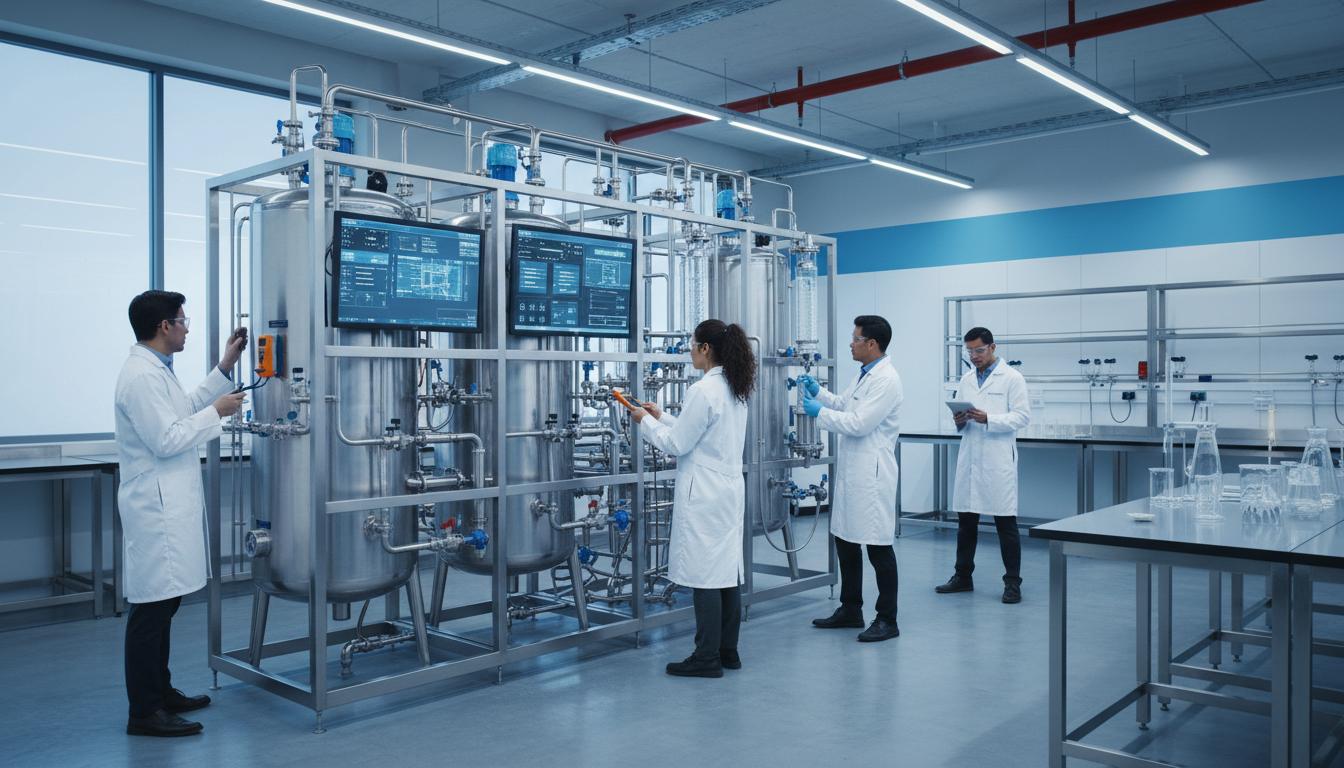
Four specialist pathways through which we translate university research into engineered reality.
We interpret your theoretical models, CFD simulations, and kinetic equations into manufacturable equipment drawings. Every dimension traceable to a research parameter.
Explore Design ProcessCompact, instrumented pilot rigs built to your exact research protocol. Delivered to your laboratory ready for connection to your influent and data acquisition systems.
Explore Pilot SupportOur chemical and process engineers advise on scale-up feasibility, material selection for novel chemistries, and regulatory compliance for research equipment.
Explore ConsultancyComplete treatment systems for university research centres, including influent preparation, reaction vessels, separation stages, and effluent monitoring.
Explore Facility SystemsStandard equipment manufacturers adapt catalogue products to approximate your needs. We engineer from your research parameters to meet your calculated results precisely.
Our engineers review your published research, understand your kinetic models and dimensionless correlations, and design equipment that preserves every assumption and coefficient.
We work through design reviews with your research team, adjusting geometry and instrumentation until the predicted performance matches your model outputs.
All equipment designed to UK university health and safety standards. COSHH assessments, pressure safety, and chemical compatibility reviewed with your safety office.
We understand research budgets. No hidden costs, clear milestone payments, and full cost breakdowns for grant applications and ethics approvals.
You share your research objectives, theoretical models, and target performance metrics.
We convert your parameters into equipment geometry, material specifications, and instrumentation design.
Joint review with your research team to verify that every calculated parameter is preserved in the design.
Manufactured in our UK facility with full traceability, QA documentation, and material certification.
Installed at your facility with commissioning support to verify performance against your research predictions.
This treatment stage is engineered to achieve specific contaminant removal targets while providing stable, predictable performance across variable inlet conditions. Design parameters are calculated from wastewater characterisation data, regulatory requirements, and site-specific constraints including footprint, energy availability, and operator capability.
Design validated by CFD modelling and pilot testing to confirm performance guarantees.
Equipment selected for 20-year design life with minimal wearing parts and easy access.
Automated dosing and feedback control minimise reagent consumption and sludge production.
Online monitoring and data logging demonstrate continuous consent compliance.
| Design Flow | 10 – 5,000 m³/h (application specific) |
| Inlet Variability | Designed for 1:3 peak-to-average flow ratio |
| Removal Efficiency | 85 – 99% depending on target contaminant |
| Hydraulic Retention | Calculated from kinetic constants and safety factors |
| Power Consumption | 0.5 – 5.0 kWh/100 m³ (process dependent) |
| Chemical Dose | Auto-controlled based on online analysers |
| Sludge Production | 0.2 – 1.5 kg DS/kg contaminant removed |
| Materials | SS304, SS316L, or carbon steel with coating |
No treatment stage operates in isolation. This process is designed to receive conditioned influent from upstream stages and deliver effluent quality suitable for downstream processes. Hydraulic and organic loading rates are balanced across the complete treatment train to prevent bottlenecking and ensure overall plant efficiency. Our engineers model the complete flowsheet to optimise Capital expenditure and Operating expenditure across the plant lifecycle.
Screening, equalisation, and pre-treatment protect this stage from damage and overload.
Effluent quality ensures downstream biology, filtration, or disinfection performs optimally.
Reject streams, filtrate, and centrate are routed back to appropriate upstream points.
Speak with our engineering team about your research project. We will review your theoretical models, propose an equipment design that preserves every calculated parameter, and deliver a system that validates your findings at pilot or production scale.
Our expertise spans multiple industries with sector-specific water treatment solutions.