
Packaged plants, containerised plants, skid-mounted systems, research stations and water-assessment stations engineered for sites with no road access, no grid power, no permanent operator presence and no nearby supply chain. From mountain mining camps and Arctic research bases to ocean monitoring buoys and post-disaster relief, this is the equipment family designed to land at site complete, run unattended, and be swapped out as a unit when service is due.
Complete water-treatment plants delivered as a single pre-commissioned unit.
10', 20' and 40' ISO container plants hardened for off-grid deployment.
Modular skids sized to fit helicopter loads and 4×4 trailers.
Long-baseline, unattended environmental and process research stations.
From process design and equipment supply through installation, commissioning and handover, we deliver complete treatment plants as a single-responsibility turnkey package — one contract, one accountable partner, and a defined performance guarantee.
Explore Turnkey DeliveryThe Five Constraints That Standard Plant Cannot Meet
A conventional water-treatment plant assumes a building, a grid power supply, an attendance roster, a local plumber and a parts cupboard within an hour's drive. None of those assumptions hold at the kinds of sites covered on this page. The engineering response is to compress as much of the plant as possible into a self-contained delivery, drive every variable that needs an operator into automation or telemetry, and design the maintenance model around a swap-out rather than an on-site repair.
Site may be helicopter-only, sea-only, ice-road-only or air-drop. The whole plant must be sized inside the transport envelope of the worst-case leg of the journey.
No grid. Power must come from the plant itself: diesel generator, solar/battery hybrid, fuel cell or local hydro. The plant has to manage its own electrical infrastructure.
No permanent staff. Automation has to handle start-up, normal running, fault recovery, blowback cleaning and shutdown. Surface telemetry is the only human in the loop.
No local supply chain. Plant carries an on-board spares kit for 6–12 months of consumables. Long-life components are specified throughout to push the next service visit out.
Dust, salt, snow, ice, UV, monsoon, hurricane, seismic, frost-heave. The plant has to survive its environment, not just operate in it. Tropicalisation and arctic-hardening are routine.
Site may have no terrestrial comms. Satellite, HF radio or store-and-forward telemetry is built in for SCADA, alarms and software updates.
Browse the Catalogue
Complete water-treatment plants delivered as a single pre-commissioned package. Intake, treatment, distribution, controls and accommodation interface in one delivery. Best for: villages, camps, expedition bases.
Explore packaged plants10′, 20′ and 40′ ISO-container plants hardened for off-grid deployment. Insulated, dust-sealed, salt-air-rated, ATEX where required. Best for: standardised plant in known logistics chains.
Explore containerised plantsModular skids sized to fit the smallest leg of the transport chain — helicopter sling-load, light truck, ATV trailer, raft. Bolted together on site. Best for: helicopter-access, mountain and island sites.
Explore skid-mounted plantsLong-baseline environmental and process-research stations engineered to run unattended for months. Sample handling, refrigeration, analytical kit and SCADA. Best for: oceanographic, polar, desert, lake research.
Explore research stationsMobile pre-design stations that characterise the source water and effluent — flow, BOD/COD/TSS, contaminant profile, treatability trials — before a permanent plant is committed. Best for: greenfield site survey, treatability validation.
Explore assessment stationsCylindrical submerged plantrooms for sites where surface real estate is unavailable or visual impact unacceptable. Same engineering philosophy applied below water rather than above.
Explore underwater plantroomsWhat the Equipment Has to Survive Before It Treats a Single Litre
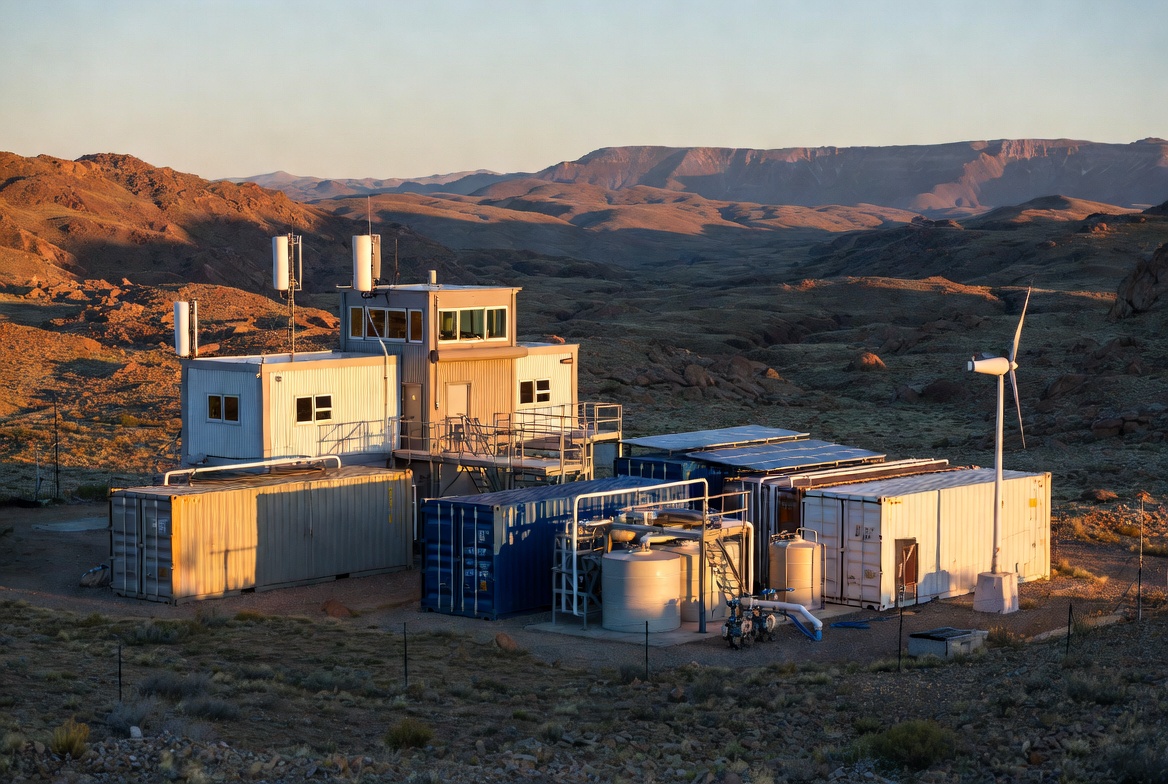
Representative remote installations — mountain, polar, desert and offshore. The treatment plant is often the only piece of infrastructure within 100 km.
Water-treatment plant designed for an industrial estate makes a poor remote-site asset. The same coagulation, clarification, filtration and disinfection physics still apply, but the surrounding assumptions all collapse. There is no grid to plug into, no road for the spare-parts van, no in-house maintenance team, no friendly equipment supplier 30 minutes away. The plant has to bring its own infrastructure with it and survive on its own once delivered.
Below is the list of challenges that drive almost every design decision on a remote installation. Each one is the difference between a plant that performs and a plant that fails its first winter.
The engineering response is to compress the plant into a self-contained delivery, automate every variable that would otherwise need a person, and design the maintenance model around a swap-out rather than an on-site repair. Each of the five product families on this page applies that response in a different way.
Industries & Site Types
Drinking water and wastewater plant for exploration camps, satellite mines and processing camps in mountain, desert and tundra environments. Often the only road in is the mine's own haul road.
Camp water and produced-water treatment for drilling pads, work-over sites and satellite production facilities. Often ATEX-rated and tropicalised or arctic-hardened.
Plantrooms and research stations at sea cages, on platforms and at marine research moorings. Salt-air corrosion is the dominant material constraint.
Arctic and Antarctic research stations, summer-only seasonal camps, glacier and ice-shelf monitoring. Equipment must survive cold-soak shutdown and start back up unattended.
Solar-driven water treatment for desert villages, archaeological sites, expedition bases. Heat, UV, dust ingress and water scarcity are the design drivers.
Rapid-deploy potable-water and effluent plants for disaster relief, refugee camps and field hospitals. Air-droppable or sea-container deliverable within 48–72 hours.
Low-visual-impact, low-noise treatment plant for safari lodges, conservation research stations and remote eco-resorts. Sustainability metrics matter as much as engineering performance.
Drinking-water plant and small-scale desalination for islands, remote coastal villages and offshore platforms. Helicopter or barge delivery and limited skilled labour pool.
Service-water and process-water plant at remote substations, microwave towers and submarine-cable landing stations. Lights-out unattended operation with telemetry.
Seven-Stage Delivery, Typically 16–28 Weeks
Site visit or hydrography review, transport-chain audit, design environment.
P&ID, control narrative, automation, electrical SLD, materials selection.
Shop fabrication, equipment integration, witnessed factory acceptance test.
Truck / ship / air / heli sling-load — transport plan engineered to the worst-case leg.
Site mounting, hot commissioning, telemetry handover, operator training.
Telemetry-driven proactive maintenance, swap-out spares strategy, planned-visit cadence.
The Decisions That Determine Whether a Remote Plant Survives 10 Years
Stainless 316L as baseline; duplex 2205 for chloride-rich service; FRP for non-pressure tankage. Painted carbon steel only inside dry, climate-controlled zones.
Design ambient envelope ranges from −55 °C (Arctic) to +55 °C (desert). Heat tracing, lagging, fan cooling and ambient compensation built into the control narrative.
Diesel generator sets with auto-changeover; solar-battery hybrids with diesel back-up; fuel cells for ultra-quiet operation. Plant load shedding under DG-only conditions.
PLC-controlled with HMI; redundant comms (satellite + cellular + LoRaWAN); SCADA tie-in to the operator’s shore room. Edge analytics for predictive maintenance.
Designed-for-swap: critical assets are quick-release. Spare-unit philosophy on fleet operators. Planned service visits at 6, 12 and 24-month intervals.
Consumables (filter cartridges, membranes, chemicals) sufficient for 6–12 months. Critical-spare kit (pump, motor, valve) on-board so a single courier visit fixes most faults.
Lone-worker monitors, fixed gas detection, automatic fire-suppression in enclosed spaces, ATEX-rated equipment in oil & gas service.
Bunded chemical storage, double-walled fuel tanks, oil-spill kit and trained operator response. Discharge monitoring with consent-aware alarms.
Primary satellite link; secondary cellular; tertiary HF/LoRaWAN store-and-forward. The plant can always be reached by SCADA even when the local link is down.
Quick Selection Guide
| Family | Typical Size | Transport | Site Build | Best Application |
|---|---|---|---|---|
| Packaged Plant | 20–500 m³/day | Truck or barge (1–3 lifts) | Single foundation, set down | Permanent village, mining camp, expedition base |
| Containerised | 5–200 m³/day | ISO container (10′, 20′, 40′) | Crane lift onto pad | Standardised plant with existing logistics chain |
| Skid-Mounted | 1–50 m³/day | Heli sling, 4×4 trailer, ATV | Bolt-together assembly | Helicopter-only site, mountain, island |
| Research Station | Project-specific | Mixed (depends on programme) | Permanent installation | Long-baseline environmental research, monitoring |
| Assessment Station | Pilot scale (0.1–5 m³/day) | Trailer, container or skid | Site-set, no foundation | Treatability trials, source-water characterisation |
Complete plants delivered as a single pre-commissioned unit.
Read MoreISO-container plants hardened for off-grid deployment.
Read MoreModular skids for helicopter and light-vehicle access.
Read MoreLong-baseline environmental and process research.
Read MoreSource-water characterisation and treatability trials.
Read MoreSister family — cylindrical submerged plantrooms.
Read MoreStandard-duty containerised systems for industrial sites.
Read MoreEN 1090 EXC3 fabrication and FAT.
Read MoreSend us the site coordinates, the transport chain and the duty — we will scope a remote-deployment package within two weeks.
Deploying containerised plants in 50 °C ambient, dust-storm zones or solar-powered off-grid sites changes almost every engineering assumption. Our hot-climate technical library covers thermal balance, solar shading, dust ingress, power systems, brackish water chemistry and the full deployment checklist:
Overview of the six engineering domains, design ambient conditions, customer profiles.
ViewHVAC sizing, insulation U-values, derating curves, pump cavitation.
ViewCool-roof coatings, cantilever shade, UV-stable materials.
ViewIP ratings, three-stage HVAC filtration, silica-gel breathers, silicone seals.
ViewPV derating, generator derating, battery cooling, hybrid sizing, fuel logistics.
ViewBrackish bore TDS, scaling species, hot-feed RO, evaporation losses.
ViewSix-step project plan from site assessment to operational hand-over.
ViewOur expertise spans multiple industries with sector-specific water treatment solutions.