
Advanced separation and biological processes that remove dissolved and suspended organic matter, nutrients, and contaminants. The core of every wastewater treatment plant where BOD, COD, and nutrient targets are achieved.
CFD, P&ID, SCADA and commissioning for critical water treatment plants.
Plant layouts, piping isometrics and construction-ready engineering drawings.
Flow, mixing and thermal CFD across treatment and process equipment.
Full mechanical, physico-chemical, biological and sludge equipment range.
Removing dissolved organics, nutrients, and suspended contaminants
Secondary treatment transforms raw effluent into environmentally safe discharge through a combination of physical separation, biological oxidation, and chemical conditioning. Reynolds & Bauhm engineers each secondary stage as part of an integrated treatment train, ensuring that upstream and downstream processes work in harmony to achieve compliance targets consistently.
Dissolved air flotation removes fats, oils, grease, and light suspended solids by attaching micro-bubbles to particles and floating them to the surface for skimming.
MBBR, SBR, and activated sludge systems use microbial communities to oxidise organic matter, convert ammonia to nitrate, and remove phosphorus through enhanced biological uptake.
Coagulation, flocculation, and chemical precipitation condition wastewater for solids separation and remove specific contaminants such as phosphorus, heavy metals, and colour.
Superior separation for FOG, TSS, and light solids
Dissolved air flotation generates micro-bubbles by saturating a recycle stream with air under pressure, then releasing it into the influent. These bubbles attach to suspended particles and oil droplets, reducing their effective density and causing them to rise to the surface where they are removed by a skimming mechanism.
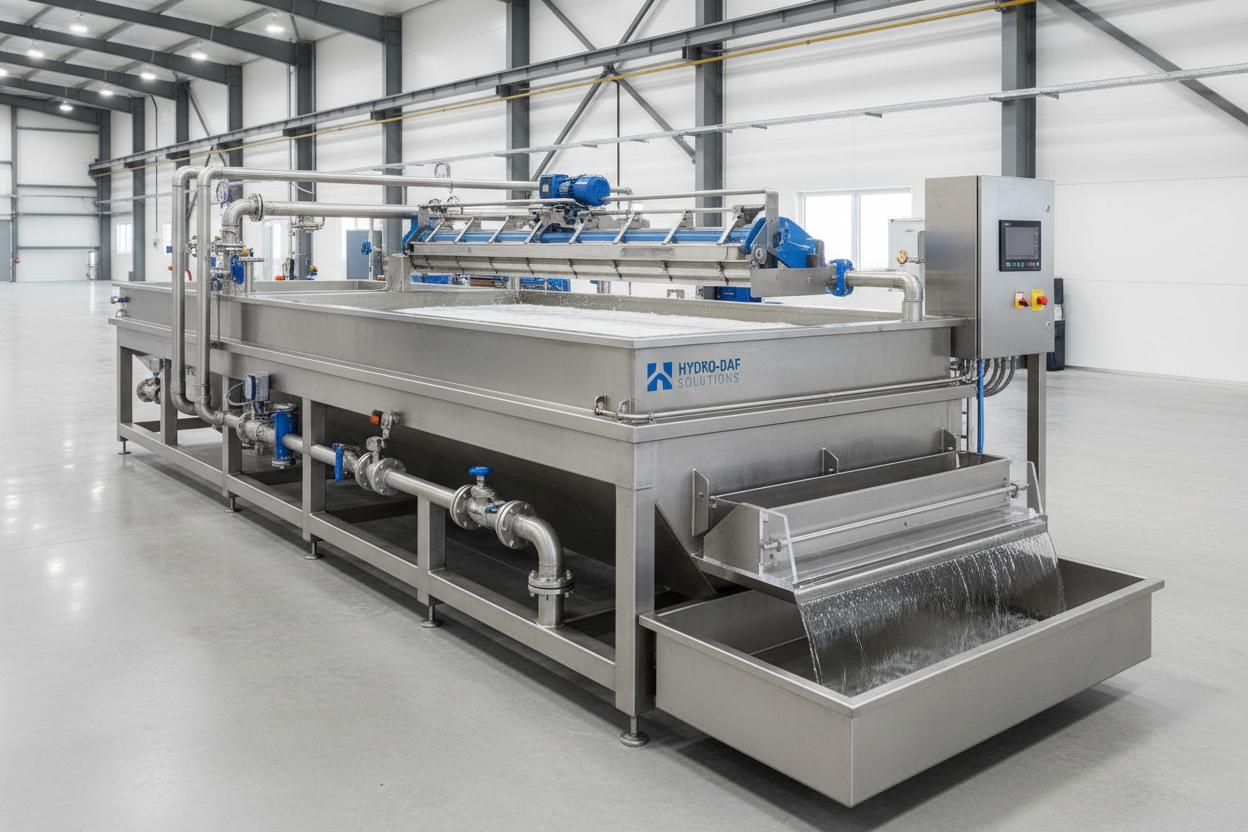
Rectangular and circular DAF units for flows from 5 to 500 m³/hr. Stainless steel construction with integral chemical mixing, reaction, and separation zones.
View Standard DAFSpace-constrained DAF units with integrated inclined plate settlers for enhanced solids removal in a compact footprint. Ideal for retrofit applications.
View DAF LamellaHigh hydraulic loading DAF systems for large flow applications and peak flow management. Designed for municipal and high-volume industrial installations.
View High-Rate DAFMBBR, SBR, and activated sludge for organic and nutrient removal
Moving bed biofilm reactors with floating biofilm carriers that provide a high surface area for microbial attachment. No sludge recycle required, compact footprint, and resilient to shock loads. Ideal for industrial applications with variable organic loading.
View MBBR SystemsSequencing batch reactors that perform aeration, settling, and decanting in a single tank. Flexible operation with programmable cycles for fill, react, settle, and draw phases. Excellent for small to medium flow applications with intermittent operation.
View SBR SystemsConventional and extended aeration activated sludge systems with clarifier separation and sludge recycle. Proven technology for municipal and industrial applications with steady-state operation and comprehensive nutrient removal capability.
View Activated SludgeUpflow anaerobic sludge blanket and expanded granular sludge bed reactors for high-strength industrial effluents. Generate biogas from organic matter while reducing BOD and COD with minimal energy input.
View Anaerobic ReactorsEnhanced biological phosphorus and nitrogen removal through alternating anaerobic, anoxic, and aerobic zones. Meet stringent total nitrogen and phosphorus discharge limits without excessive chemical dosing.
View Nutrient RemovalPre-engineered containerised biological treatment plants for rapid deployment to remote sites, temporary applications, and phased plant expansions. Plug-and-play design minimises civil works.
View Containerised PlantsCoagulation, flocculation, pH correction, and precipitation
Chemical treatment optimises wastewater for physical separation and removes specific contaminants that biological processes cannot address. Reynolds & Bauhm designs chemical dosing systems with precise polymer preparation, inline mixing, and automated control to achieve consistent conditioning at varying flow and load.
This treatment stage is engineered to achieve specific contaminant removal targets while providing stable, predictable performance across variable inlet conditions. Design parameters are calculated from wastewater characterisation data, regulatory requirements, and site-specific constraints including footprint, energy availability, and operator capability.
Design validated by CFD modelling and pilot testing to confirm performance guarantees.
Equipment selected for 20-year design life with minimal wearing parts and easy access.
Automated dosing and feedback control minimise reagent consumption and sludge production.
Online monitoring and data logging demonstrate continuous consent compliance.
| Design Flow | 10 – 5,000 m³/h (application specific) |
| Inlet Variability | Designed for 1:3 peak-to-average flow ratio |
| Removal Efficiency | 85 – 99% depending on target contaminant |
| Hydraulic Retention | Calculated from kinetic constants and safety factors |
| Power Consumption | 0.5 – 5.0 kWh/100 m³ (process dependent) |
| Chemical Dose | Auto-controlled based on online analysers |
| Sludge Production | 0.2 – 1.5 kg DS/kg contaminant removed |
| Materials | SS304, SS316L, or carbon steel with coating |
No treatment stage operates in isolation. This process is designed to receive conditioned influent from upstream stages and deliver effluent quality suitable for downstream processes. Hydraulic and organic loading rates are balanced across the complete treatment train to prevent bottlenecking and ensure overall plant efficiency. Our engineers model the complete flowsheet to optimise Capital expenditure and Operating expenditure across the plant lifecycle.
Screening, equalisation, and pre-treatment protect this stage from damage and overload.
Effluent quality ensures downstream biology, filtration, or disinfection performs optimally.
Reject streams, filtrate, and centrate are routed back to appropriate upstream points.
Aeration accounts for 50–70 % of a biological plant’s electrical Operating expenditure — designing it well is the single largest lifetime saving.
kLa, OTR, SOTR and the alpha-factor corrections that anchor every aerator sizing calculation.
Read MoreSurface, diffused, jet and venturi systems compared head-to-head.
Read MoreFine-bubble grids for activated-sludge, MBBR and aerobic biological treatment.
Read MoreValidate diffuser layout, DO field and dead zones before commissioning concrete or steel.
Read MoreSpeak with our process engineers to determine the optimal combination of DAF, biological, and chemical treatment for your effluent profile and discharge requirements.
Our expertise spans multiple industries with sector-specific water treatment solutions.