
Reynolds & Bauhm builds compact, instrumented pilot testing rigs for UK university research. Delivered to your laboratory ready for connection to your influent and data acquisition systems.
Every breakthrough in water treatment starts at the bench. But validating that breakthrough at pilot scale demands equipment that reproduces your controlled laboratory conditions with fidelity, not approximation.
We build pilot testing rigs specifically for university research environments. Compact enough for laboratory halls. Instrumented for your data acquisition system. Fabricated to preserve the reaction conditions, hydraulic profiles, and mass transfer characteristics your research depends on.
Compact skids and tabletop units designed around standard laboratory dimensions. Quick-connect fittings for building services. No civil works required.
Instrumentation outputs compatible with LabVIEW, MATLAB, and standard DAQ hardware. 4-20 mA, Modbus, and digital outputs where your protocol needs them.
Designed to your institution's health and safety requirements. COSHH containment, emergency stops, and spill trays as standard. Full risk assessment documentation.
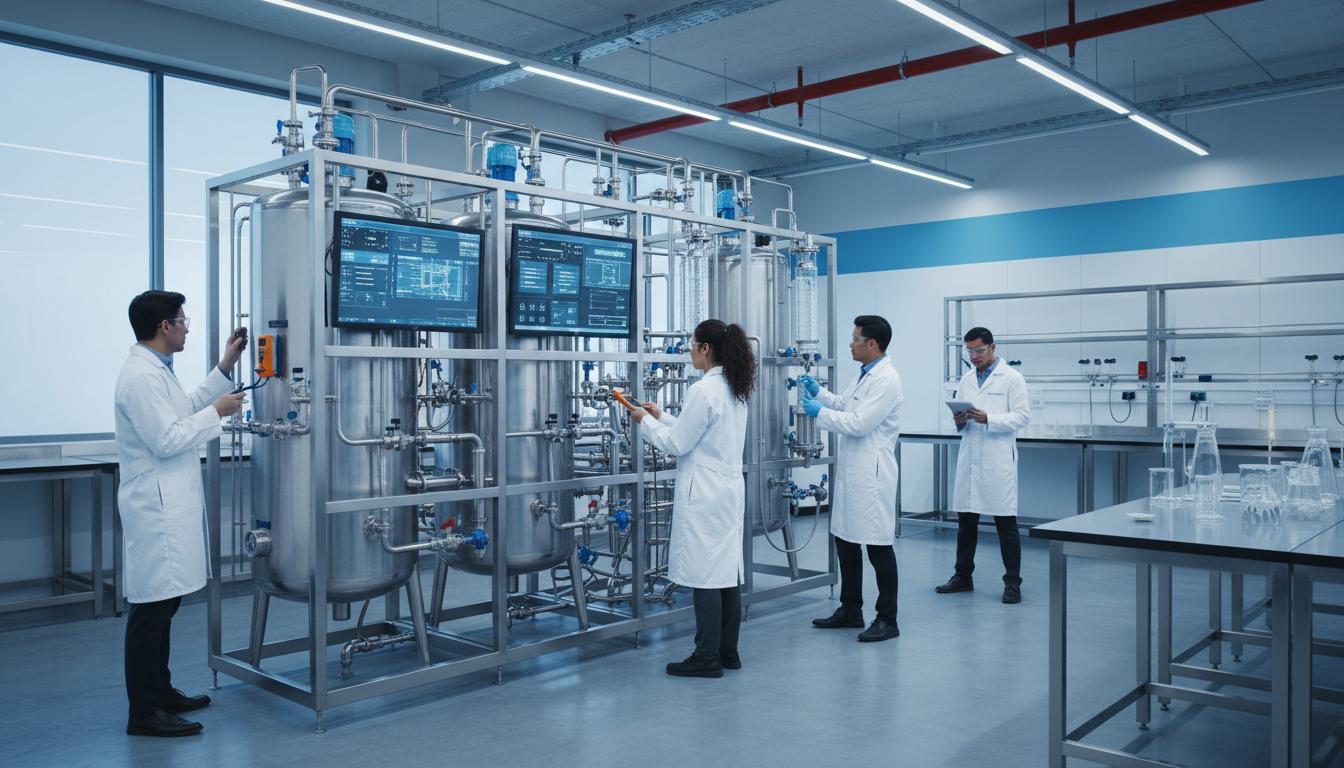
Configurable pilot rigs for the most common university water and wastewater research programmes.
Pressure and gravity filtration pilots with variable media depth, adjustable flow rates, and real-time headloss monitoring. For research into media selection, fouling behaviour, and backwash optimisation.
Dissolved air flotation pilots with adjustable pressure, recycle ratio, and rise velocity. Instrumented for bubble size distribution measurement and floated solids capture analysis.
MBBR, MBR, and SBR pilots with controlled aeration, variable HRT, and online DO, pH, and ORP monitoring. For research into microbial kinetics, biofilm development, and nutrient removal.
Coagulation and flocculation jar-test to pilot-scale systems with variable mixing intensity, dosing rate control, and online turbidity and zeta potential measurement.
Multi-disc screw press and belt press pilots with adjustable belt speed, pressure, and polymer dosing. Instrumented for cake solids, filtrate quality, and specific resistance measurement.
Column and batch contact pilots for GAC, resin, and novel adsorbent research. With adjustable contact time, pH control, and automated sampling for breakthrough curve analysis.
Adjustable flow rates, detention times, mixing speeds, and chemical dosing rates through the full range your research protocol requires. Not stepped presets, but continuous variable control.
pH, temperature, dissolved oxygen, turbidity, conductivity, and oxidation-reduction potential sensors positioned where your sampling protocol needs them. Calibrated before dispatch.
Timed or flow-paced sample collection ports at every process stage. Quick-connect fittings for your analytical equipment. No disruption to hydraulic conditions during sampling.
SD card logging and real-time USB output as standard. Optional Modbus TCP, OPC-UA, or MQTT for direct integration with your laboratory SCADA or data historian.
Delivered pre-commissioned and wet-tested at our facility. Connect your influent, drain, and power at your laboratory and begin experiments the same day.
Complete P&ID, operation manual, calibration certificates, and performance prediction report. Everything your ethics committee and grant body requires.
This treatment stage is engineered to achieve specific contaminant removal targets while providing stable, predictable performance across variable inlet conditions. Design parameters are calculated from wastewater characterisation data, regulatory requirements, and site-specific constraints including footprint, energy availability, and operator capability.
Design validated by CFD modelling and pilot testing to confirm performance guarantees.
Equipment selected for 20-year design life with minimal wearing parts and easy access.
Automated dosing and feedback control minimise reagent consumption and sludge production.
Online monitoring and data logging demonstrate continuous consent compliance.
| Design Flow | 10 – 5,000 m³/h (application specific) |
| Inlet Variability | Designed for 1:3 peak-to-average flow ratio |
| Removal Efficiency | 85 – 99% depending on target contaminant |
| Hydraulic Retention | Calculated from kinetic constants and safety factors |
| Power Consumption | 0.5 – 5.0 kWh/100 m³ (process dependent) |
| Chemical Dose | Auto-controlled based on online analysers |
| Sludge Production | 0.2 – 1.5 kg DS/kg contaminant removed |
| Materials | SS304, SS316L, or carbon steel with coating |
No treatment stage operates in isolation. This process is designed to receive conditioned influent from upstream stages and deliver effluent quality suitable for downstream processes. Hydraulic and organic loading rates are balanced across the complete treatment train to prevent bottlenecking and ensure overall plant efficiency. Our engineers model the complete flowsheet to optimise Capital expenditure and Operating expenditure across the plant lifecycle.
Screening, equalisation, and pre-treatment protect this stage from damage and overload.
Effluent quality ensures downstream biology, filtration, or disinfection performs optimally.
Reject streams, filtrate, and centrate are routed back to appropriate upstream points.
Systematic experimental design using factorial and response surface methods to maximise information from limited experimental runs while controlling costs.
Integrated online COD, TOC, pH, turbidity, and flow measurement with automated data logging to university SCADA or cloud platforms.
Rigorous input-output mass balancing with analytical validation to ensure experimental data integrity and support peer-reviewed publication.
Gas detection, emergency stop, pressure relief, and spill containment designed to university health and safety standards with full risk assessments.
Our pilot rigs generate publication-quality data with full traceability. Every sensor is UKAS-calibrated, every sample is chain-of-custody documented, and every result is cross-checked against mass balances and theoretical predictions.
Beyond academic publication, we support the commercial translation of successful pilots through scale-up engineering, techno-economic analysis, and investor engagement.
Tell us about your research protocol. We will design and build a pilot rig that reproduces your bench-scale conditions with the fidelity your peer review demands.
Our expertise spans multiple industries with sector-specific water treatment solutions.