
Advanced dissolved air flotation systems for efficient solids separation, oil & grease removal, and wastewater clarification across industrial and municipal applications
Free interactive DAF sizing calculator. Calculate dissolved air flotation surface area, recycle flow, saturator volume, and power.
FOG removal food industry DAF systems for fat oil grease recovery food processing.
DAF systems for oil and gas produced water and refinery wastewater treatment.
Design DAF systems for correct hydraulic loading. Surface area, rise rate and detention time calculations for your flow.
Dissolved Air Flotation systems for industrial and municipal wastewater clarification
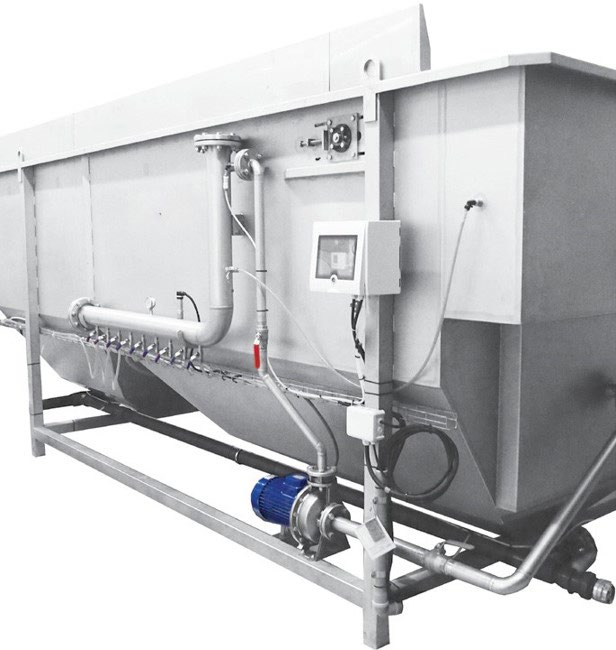
Dissolved Air Flotation (DAF) is a highly effective water treatment process that clarifies wastewater by removing suspended solids, oil and grease, and other contaminants through micro-bubble flotation. Air is dissolved in water under pressure and released at atmospheric pressure in a flotation tank, creating millions of microscopic bubbles that attach to suspended particles and float them to the surface for removal.
Our DAF units are engineered for superior performance across food processing, industrial wastewater, municipal treatment, and oil-water separation. With removal efficiencies up to 99% for oil and grease and 95% for suspended solids, Reynolds & Bauhm systems deliver consistent results while minimising operational costs and footprint.
The Dissolved Air Flotation Process
The DAF process utilises the principle of micro-bubble flotation to achieve rapid and efficient separation of suspended solids, oils, and other contaminants from water and wastewater streams.
Clean water is pressurised to 4-6 bar in the saturator vessel, dissolving air into the water under pressure using efficient pall ring packing media.
Coagulants and flocculants are added to the influent wastewater to destabilise particles and promote aggregation into larger flocs.
Pressurised water is released through nozzles, creating millions of micro-bubbles (30-100 microns) that attach to suspended particles.
Air-particle aggregates rise to the surface, forming a stable sludge blanket that is continuously removed by a scraper mechanism.
Clean water exits from the bottom of the flotation cell, ready for discharge or further treatment, with optional pH correction.
Solutions for Every Application Scale
Space-efficient DAF systems engineered for small to medium flow applications where footprint is critical. Ideal for food processing facilities, small industrial plants, and pilot testing operations. The compact design integrates all process components including saturator, flotation cell, and sludge handling in a single skid-mounted unit.
Up to 40% smaller than conventional DAF systems, ideal for space-constrained installations
Pre-assembled and factory-tested for rapid installation, commissioning and handover
5-50 m³/h capacity with standard models, custom sizes available
Versatile dissolved air flotation systems for medium to large flow applications. The standard series offers optimal balance between performance, footprint, and operational flexibility. Suitable for municipal wastewater, industrial pre-treatment, and food & beverage processing with flows up to 200 m³/h.
Optimised hydraulic design ensures uniform bubble distribution and maximum separation efficiency
Large access hatches and removable components simplify inspection and maintenance
50-200 m³/h capacity with multiple cell configurations available
Heavy-duty DAF systems engineered for demanding industrial applications with high solids loading, variable flow conditions, and challenging wastewater characteristics. Features reinforced construction, abrasion-resistant materials, and enhanced sludge handling capabilities for continuous 24/7 operation.
Reinforced steel construction with corrosion-resistant coatings for harsh environments
Enhanced sludge removal systems capable of handling up to 5% solids concentration
100-500 m³/h capacity with parallel cell configurations for higher flows
Complete DAF treatment plants housed in standard shipping containers for rapid deployment and mobility. Pre-piped, pre-wired, and factory-tested systems ready for immediate operation. Ideal for temporary treatment needs, remote locations, and emergency response situations.
Plug-and-play systems ready for operation within hours of delivery
Standard container dimensions enable easy transport by truck, rail, or ship
10-100 m³/h capacity in 20ft and 40ft container configurations
Engineering Data & Performance Metrics
| Parameter | DF DAF-C (Compact) | DF DAF-S (Standard) | DF DAF-I (Industrial) | DF DAF-COM (Containerised) |
|---|---|---|---|---|
| Flow Rate Range | 5-50 m³/h | 50-200 m³/h | 100-500 m³/h | 10-100 m³/h |
| TSS Removal Efficiency | Up to 95% | Up to 95% | Up to 95% | Up to 92% |
| Oil & Grease Removal | Up to 99% | Up to 99% | Up to 99% | Up to 97% |
| Hydraulic Retention Time | 15-30 minutes | 20-40 minutes | 25-45 minutes | 20-35 minutes |
| Air-to-Solids Ratio (A/S) | 0.02-0.05 | 0.02-0.05 | 0.03-0.06 | 0.02-0.04 |
| Saturator Pressure | 4-6 bar | 4-6 bar | 4-6 bar | 4-5 bar |
| Recycle Ratio | 10-30% | 10-30% | 15-35% | 10-25% |
| Sludge Concentration | 3-5% | 3-5% | 4-7% | 3-4% |
| Material Options | SS 304/316, Coated CS | SS 304/316, Coated CS | SS 316, Duplex, Coated CS | SS 304/316 |
| Operating Temperature | 5-40°C | 5-40°C | 5-60°C | 5-40°C |
Industries & Processes We Serve
Operational & Environmental Benefits
DAF systems offer lower operational costs compared to conventional sedimentation, with smaller footprint requirements, reduced chemical consumption, and lower sludge handling costs. Energy-efficient saturator designs minimise power consumption.
DAF units require 30-50% less space than conventional clarifiers for equivalent treatment capacity, reducing capital costs for building construction and land requirements in space-constrained facilities.
DAF systems achieve stable performance within minutes of start-up, compared to hours for biological systems. This enables flexible operation for batch processes and variable flow conditions.
Consistently achieve discharge limits for TSS, oil & grease, and BOD. Our DAF systems help facilities meet environmental regulations including EPA, EU Water Framework Directive, and local discharge standards.
High-quality DAF effluent is suitable for recycling within the facility for non-potable applications such as cooling tower makeup, wash water, or irrigation, reducing freshwater consumption and discharge volumes.
DAF produces concentrated sludge with 3-7% solids content, significantly reducing sludge volume compared to gravity clarification. This translates to lower dewatering and disposal requirements.
Real-World Treatment Results
Poultry processing facility achieving consistent effluent quality below 30 mg/L TSS, meeting local discharge requirements.
API separator upgrade reducing oil content from 150 mg/L to <5 mg/L, enabling water reuse for cooling systems.
Phosphorus removal upgrade achieving <0.5 mg/L total phosphorus, meeting stringent EU discharge standards.
SCADA Integration Available
Our DAF units can be equipped with advanced control systems for fully automated operation. PLC-based controls with HMI interface enable real-time monitoring of critical parameters, automatic chemical dosing adjustment, and remote diagnostics. Integration with SCADA systems provides centralised control and data logging for compliance reporting.
Complete Treatment Solutions
Validate DAF performance with your specific wastewater through on-site pilot testing. Our mobile pilot units enable optimisation of operating parameters before full-scale implementation.
Learn About Pilot TestingComplete process design and P&ID development for DAF integration into your existing Treatment Process. Our engineers ensure optimal hydraulic and chemical conditioning.
View P&ID Design ServicesOptimise coagulation and flocculation chemistry for your DAF system. Reynolds & Bauhm provides chemical selection, dosing equipment, and ongoing optimisation support.
View Chemical Treatment ServicesPolishing filtration for DAF effluent to achieve higher water quality for reuse applications. Multimedia, sand, and activated carbon filters available.
View Filtration SystemsPre-engineered containerised treatment plants for rapid deployment. Complete DAF, biological, and filtration systems in standard shipping containers.
Explore Containerised SystemsComplete physico-chemical conditioning and treatment solutions including DAF systems, coagulation/flocculation, and sedimentation technologies.
Explore Physico-ChemicalSludge dewatering equipment to process DAF float solids. Screw presses, centrifuges, and multi-disc thickeners for efficient solids handling.
View Sludge ManagementCustom automation and SCADA integration for critical water treatment processes plants.
View PageOur custom engineering team is involved in designing water treatment equipment to your exact specifications.
View PageAdvanced material selection and protective coatings for aggressive wastewater environments.
View PageWe design bespoke water treatment systems with guaranteed performance targets.
View PageSeamlessly integrate new water treatment equipment with your existing infrastructure.
View PageThe mechanical detail behind a DAF skid: tank, scraper, saturator, white-water distribution.
Rectangular tank standard for sites up to 200 m³/h; circular for larger. Length:width 3:1 to 5:1 typical. Inlet baffle dissipates feed momentum.
Packed tower (steel + pall rings or random packing) or cyclonic. Air-water contact 6–15 sec. Air dissolution 60–95% at 5 bar.
Critical zone. Header pipe with perforated diffusers spaced 100–200 mm. Release valve pressure drop creates micro-bubbles. CFD-optimised for uniformity.
Continuous belt-and-flight or rotary skimmer. Float (skim) sludge to side channel. Speed adjustable for scum depth and consistency.
Hopper bottom with desludge valves; pneumatic timer-operated. Heavy settled solids periodically drained to bottom sludge holding tank.
Carbon steel + epoxy for fresh water; SS304L for general industrial; SS316L for chloride; duplex 2205 for high-chloride or produced water; CuNi for seawater.
Contact our engineering team to discuss your wastewater treatment requirements and receive a customised DAF system design.
Stokes’-law sizing, API Publication 421 design methodology, rectangular API / CPI / TPI configurations and refinery-train integration.
Sizing, components, types, materials, codes & compliance — the full engineering reference for gravity oil-water separation.
Read the API Separators PageCompare the three dominant configurations side-by-side — droplet cut-size, footprint, Operating expenditure and best-fit applications.
Compare Separator TypesCFD-verified F-factor for shorter basins, optimised inlet diffusers and reduced civils Capital expenditure.
CFD EngineeringOur expertise spans multiple industries with sector-specific water treatment solutions.