
Large-scale granular activated carbon (GAC) contactor installations — outdoors on reinforced concrete pads, indoors within water treatment works, or as containerised packages — provide the definitive treatment step for taste, odour, colour, dissolved organics, chlorination by-products and micropollutant removal in drinking water supply. Banks of 6–24 contactor vessels deliver the empty bed contact time (EBCT) required to achieve regulatory compliance at full-works capacity.
Design and engineering guide for pressure multimedia filter installations. Vessel sizing, manifold layout, backwash automation and commissioning for drinking water treatment at 5-100 MLD.
Multimedia Filter by Reynolds & Bauhm. Industrial water and wastewater treatment solutions engineered for efficiency, durability and worldwide compliance.
Engineering guide to horizontal pressure filter vessels for low-headroom sites. Factory-assembled skid units with multiple manways, automated backwash PLC and full PED compliance.
Aeration and destratification for drinking-water reservoirs — taste and odour control, thermal mixing, DBP precursor reduction, manganese and iron prevention.
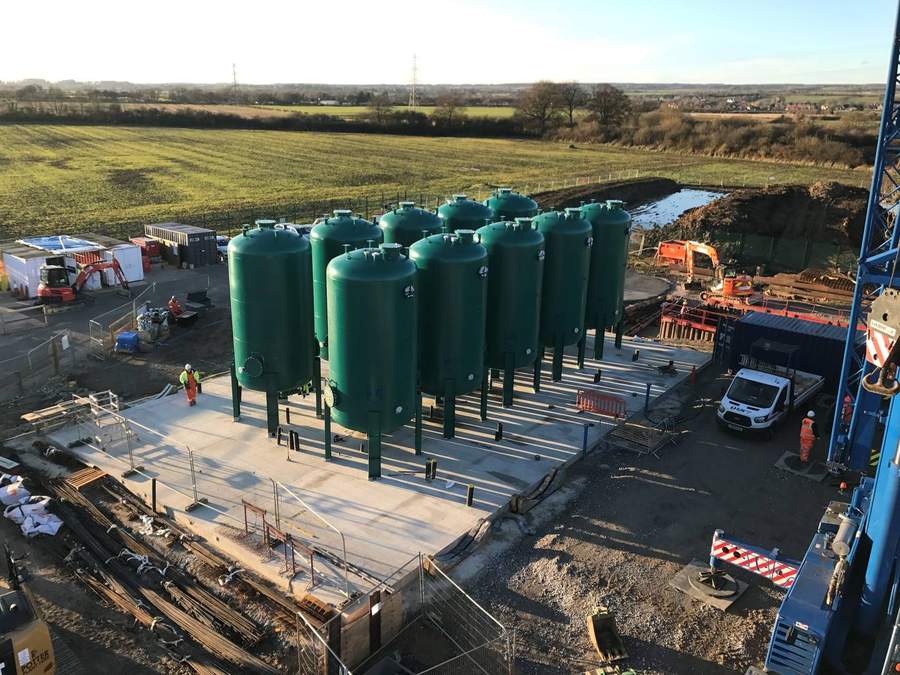
Outdoor GAC contactor installations are favoured where existing buildings cannot accommodate additional vessel banks, where the treatment works is under expansion, or where phased construction requires equipment to be installed before the permanent building is completed. The photograph below shows a 10-vessel bank installed on a civil concrete pad during a drinking water treatment upgrade.
Empty Bed Contact Time (EBCT): The primary design parameter for GAC adsorption is EBCT = GAC bed volume (m³) ÷ volumetric flow rate (m³/min). UK and European guidance (DWI 2021 GAC guidance; WHO 2017) typically requires EBCT of 10–20 minutes for taste and odour compounds (geosmin, 2-MIB), 15–30 minutes for THM and HAA precursor removal, and 20–30 minutes for micropollutants (pesticides, pharmaceuticals). EBCT determines the total GAC volume needed, which in turn drives vessel count and dimensions.
Standard GAC media grades for pressure filters: coal-based extruded GAC (ES 0.6–1.0 mm, iodine number 900–1,100 mg/g, ash < 8%) for general organics and THM precursor removal; coconut-shell GAC (ES 0.5–0.8 mm, iodine number 1,000–1,200 mg/g) for taste and odour compounds; reactivated GAC for reduced virgin carbon cost where thermal reactivation infrastructure exists. DWI Regulation 31 approval required for all UK drinking water contact media.
Outdoor GAC vessels sit on reinforced concrete pad foundations designed to BS EN 1997 with bearing pressure calculated from vessel full-of-water weight (steel + carbon + water). Pad thickness typically 300–450 mm with A252 mesh reinforcement. Vessels supported on hot-dipped galvanised or epoxy-coated structural steel legs with baseplate anchors. Interconnecting pipework: MDPE or ductile iron buried; stainless steel or HDPE exposed above slab. Bund containment optional depending on planning consent.
GAC media has a finite adsorption capacity measured by the iodine number (mg I&sub2;/g; new > 900; replace when < 600). Service life 2–5 years depending on organic load. Options on exhaustion: thermal reactivation (900°C in rotary kiln — restores 90–95% of capacity; cost ~30–40% of virgin GAC); biological activated carbon (BAC) conversion (allow biological colonisation of GAC to extend service life through biodegradation alongside adsorption); complete media replacement. Vessel drain/refill valves must be sized for full media suction tanker extraction.
GAC duty pressure vessels: SA-516 Grade 70 carbon steel, epoxy-coated internally (food-grade, DWI Reg 31), polyurethane externally for UV and weather resistance. Working pressure 4–10 bar, PED Category III. DN 1,200–3,000 mm; L:D ratio 2:1 to 4:1 to achieve EBCT with reasonable plan footprint. Vessel fittings: top domed manway (DN600), underdrain lateral system (corrosion-resistant polypropylene or SS316), bottom drain, vent, ΔP tappings, sample point, media loading nozzle.
| Parameter | Taste & Odour Removal | THM Precursor / DBP Control | Micropollutant Removal |
|---|---|---|---|
| Target EBCT (min) | 10–15 | 15–25 | 20–30 |
| Hydraulic loading rate (m/h) | 10–20 | 8–15 | 6–12 |
| GAC bed depth (m) | 1.5–3.0 | 2.0–4.0 | 2.5–5.0 |
| Media grade (iodine no.) | ≥ 900 mg/g | ≥ 900 mg/g | ≥ 1,000 mg/g |
| Typical service life (years) | 3–5 | 2–4 | 1.5–3 |
| Backwash rate (m/h) | 20–30 | 20–30 | 15–25 |
| Backwash water demand | 2–4% of throughput | 2–4% | 2–5% |
Identify the target compounds: geosmin/2-MIB (taste, odour), THM precursors (DOC/SUVA), chloramine demand, pesticides, micropollutants. Each compound requires a different minimum EBCT — design to the most demanding. Obtain influent TOC, SUVA (specific UV absorbance at 254 nm) and target compounds concentration from water quality survey or existing monitoring data.
GAC volume (m³) = design flow (m³/h) ÷ 60 × EBCT (min). Divide by bed depth (m) to get filter area (m²). Select standard vessel diameter; calculate number of vessels = filter area ÷ vessel cross-section + 1 standby. For 10 MLD at EBCT 15 min: GAC volume = 2,500 m³ of water ÷ 4 vessels at DN2000 = 2.5 m³ GAC each at 3.2 m bed depth — verify by EBCT calculation back-check.
Commission topographic and geotechnical survey of proposed outdoor pad location. Design RC pad to BS EN 1992 for full vessel weight (include water and media: GAC apparent density ~350–450 kg/m³ wet). Verify pad drainage to prevent standing water under vessels (corrosion risk). Design pipework route from existing works: buried MDPE rising main to pad; stainless steel manifold on pad; return line for backwash waste.
Procure to ASME Section VIII Div 1 or PED 2014/68/EU. Specify DWI Regulation 31 approved internal epoxy coating (e.g., Corroless P&A or Belzona 1111). Request Factory Acceptance Test (FAT): hydraulic pressure test at 1.5× WP, coating adhesion test (cross-cut per BS EN ISO 2409), dimensional inspection. Obtain EN 10204 3.1 certificates for all pressure parts.
Load DWI-approved GAC using pneumatic conveyance or gravity fill from manway. Record layer depth and media weight per vessel. Pre-condition media: backwash 3 times to remove carbon fines (discard backwash to drain); measure turbidity of backwash until clear (< 5 NTU). Run to waste for minimum 1 hour before connecting to treated water main. Take first-pass effluent samples for TOC, taste panel and target compound analysis to confirm adsorption performance.
Sample GAC filter effluent monthly for TOC, SUVA and target compounds. Track breakthrough curve: when effluent TOC rises to > 70% of influent, media is approaching exhaustion. Reserve reactivation contract 6 months in advance (reactivation kiln scheduling; lead time 4–8 weeks). Reactivated carbon must be tested for iodine number ≥ 850 before re-use and re-approved under DWI Reg 31 for drinking water contact.
Sand and anthracite pretreatment before GAC: removes TSS and turbidity that would blind carbon media and reduce service life.
Read MoreWhen GAC contactors are housed in covered or building-integrated installations for weather protection and maintenance access.
Read MoreGeosmin, 2-MIB and other taste-and-odour compounds in drinking water reservoirs — where GAC is the primary treatment technology.
Read MoreTHM and HAA formation, precursor removal strategies and the role of GAC in DBP compliance for drinking water.
Read MoreShare your design flow, target EBCT, site constraints and DWI objectives. We will specify a GAC contactor installation with full civil, structural and process engineering.
Request GAC Contactor DesignOur expertise spans multiple industries with sector-specific water treatment solutions.