
Multiphase CFD with phase-change heat transfer for evaporators, crystallisers, and dryers. Predict film distribution, boiling zones, vapour carryover, and energy consumption for maximum thermal efficiency.
CFD thermal simulation services for water treatment equipment.
CFD thermal simulation for LED lighting enclosures and heat sinks.
CFD thermal mixing simulation for tanks, reactors, and process vessels.
CFD thermal simulation for LiDAR enclosures. Predict laser diode temperature, prevent optical window condensation, and validate.
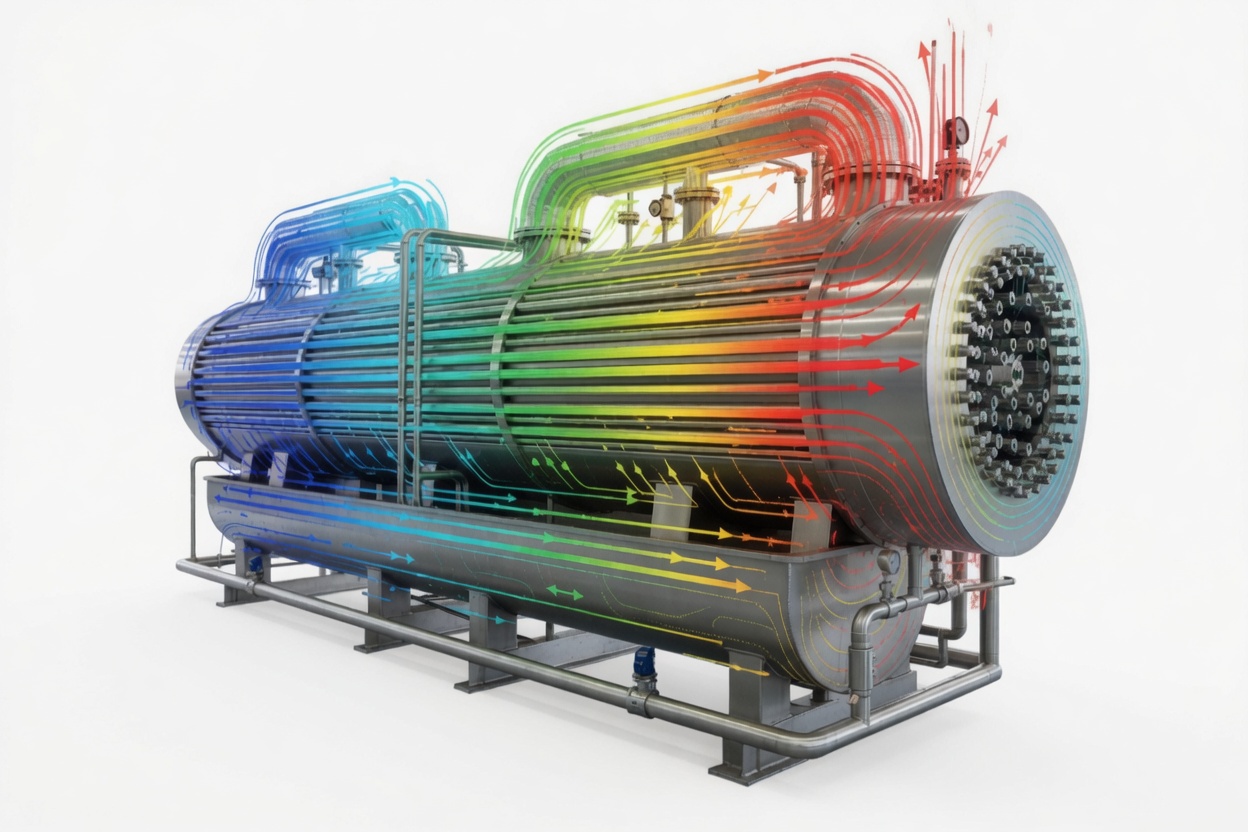
CFD vapour fraction contours in a falling-film evaporator
Evaporation and drying are energy-intensive thermal separation processes that concentrate solutions, recover solvents, or produce solid products from liquid streams. In water treatment, evaporation enables zero liquid discharge (ZLD) by crystallising dissolved salts. In food and pharmaceutical manufacturing, falling-film and forced-circulation evaporators concentrate products with minimal thermal degradation. CFD thermal simulation with phase-change modelling is essential for optimising heat transfer and preventing fouling.
Our multiphase thermal models simulate boiling, condensation, and droplet evaporation with temperature-dependent latent heat and physical properties. We analyse falling-film distribution, vapour carryover, nucleate boiling zones, and dry-patch formation that leads to scaling and product degradation. Results inform heating surface area, circulation rates, and vacuum levels for maximum energy efficiency.
Liquid distribution onto heated tubes modelled to ensure uniform film thickness, prevent dry patches, and maximise heat transfer coefficient in juice, dairy, and chemical concentration.
Recirculating flow with flash evaporation simulated to predict boiling suppression, velocity past the heating surface, and crystal suspension in crystallising evaporators.
Compressor thermodynamics coupled with evaporator heat transfer to optimise steam economy and specific energy consumption.
Direct and indirect thermal drying of dewatered sludge. Model hot gas mixing, particle residence time, and moisture evaporation to optimise throughput and energy use.
Droplet trajectory, drying kinetics, and air temperature profiles in spray drying towers for food powder and pharmaceutical granule production.
Sublimation front tracking and shelf temperature uniformity in pharmaceutical freeze-drying for injectable and biologic products.
| Evaporation Capacity | 0.5 – 100 tonnes water/hour |
| Steam Economy | 0.3 – 0.95 kg steam/kg water (MVR dependent) |
| Operating Temperature | 40 – 120°C (vacuum to atmospheric) |
| Heat Transfer Coefficient | 1,500 – 4,000 W/m²K (falling-film, water-like) |
| Concentration Range | 5 – 80% solids (product dependent) |
| Vacuum Level | 0.05 – 0.8 bar absolute |
| Specific Energy Consumption | 10 – 60 kWh/tonne water evaporated |
| Materials | SS316L, duplex, titanium, or nickel alloys |
A pharmaceutical API manufacturer required zero liquid discharge for high-salinity effluent containing organic solvents and active compounds. CFD thermal simulation of a three-effect falling-film evaporator train identified maldistribution in the first effect that caused dry patches on 15% of the tube bundle surface. These dry zones led to rapid scaling with calcium phosphate and API residue, requiring weekly acid cleaning. The CFD model recommended a revised liquid distributor with vane inserts that improved circumferential distribution uniformity from 72% to 94%. Post-modification, cleaning intervals extended to 6 weeks, evaporator availability improved from 78% to 94%, and steam consumption decreased by 18% due to the restored heat transfer area.
Extended from 1 week to 6 weeks, reducing chemical consumption and downtime.
Improved from 78% to 94%, increasing effective evaporation capacity by 20%.
18% reduction in specific steam consumption through restored heat transfer area.
Tube bundle, distributor, and vapour chamber CAD models prepared with surface roughness and weld bead features.
Volume-of-Fluid (VOF) or Eulerian-Eulerian multiphase model captures liquid film thickness, rivulet formation, and dry-patch initiation.
Nucleate boiling and convective evaporation heat transfer models applied with temperature-dependent latent heat and surface tension.
Vapour velocity, carryover droplet trajectory, and pressure drop through demisters and condensers simulated.
Distributor geometry, tube pitch, and heating steam pressure optimised for maximum evaporation rate and minimum fouling.
Heat flux maps, film thickness contours, vapour quality profiles, and design recommendations with performance guarantees.
External and internal forced convection with turbulent boundary layers, entrance effects, and developing flow regions accurately captured using low-Reynolds turbulence models.
Buoyancy-driven flow from density variations with Boussinesq and full compressible formulations for high Rayleigh number applications including solar heating and passive cooling.
Nucleate pool boiling, flow boiling, and film condensation with heat transfer coefficient correlations validated against Rohsenow and Nusselt analytical solutions.
Surface-to-surface radiation and participating media radiation for high-temperature dryers, furnaces, and combustion applications with view factor calculation.
Heat transfer through packed beds, filter media, and insulation with effective thermal conductivity and non-thermal equilibrium between fluid and solid phases.
Joule heating in immersed heaters, trace heating cables, and electrocoagulation cells with coupled electrical potential and energy equations.
Typical turnaround is 2-4 weeks for steady-state analysis and 4-8 weeks for transient simulations, depending on geometry complexity and mesh density.
STEP, IGES, or native CAD files (SolidWorks, Inventor, CATIA) are preferred. 2D drawings with critical dimensions are acceptable for simpler geometries.
Yes, our CFD-based performance predictions are backed by contractual guarantees when validated against pilot testing or field correlation.
Yes, we model boiling, condensation, freezing, melting, and evaporation using volume-of-fluid, mixture, and Eulerian-Eulerian multiphase approaches.
Typical projects vary from for single-component analysis to for full system optimisation with parametric studies.
Yes, we recommend combined CFD + pilot testing for high-value projects, using CFD to design the pilot and pilot data to validate the full-scale model.
CFD thermal simulation identifies hotspots, thermal gradients, and inefficiencies before capital is committed. Speak with our thermal simulation engineers to model your heat transfer challenge.
Our expertise spans multiple industries with sector-specific water treatment solutions.