
Conjugate heat transfer CFD for plate, shell-and-tube, and spiral heat exchangers. Predict thermal performance, identify fouling hotspots, and optimise energy efficiency before fabrication.
CFD thermal simulation services for water treatment equipment.
CFD thermal simulation for LED lighting enclosures and heat sinks.
CFD thermal mixing simulation for tanks, reactors, and process vessels.
CFD thermal simulation for LiDAR enclosures. Predict laser diode temperature, prevent optical window condensation, and validate.
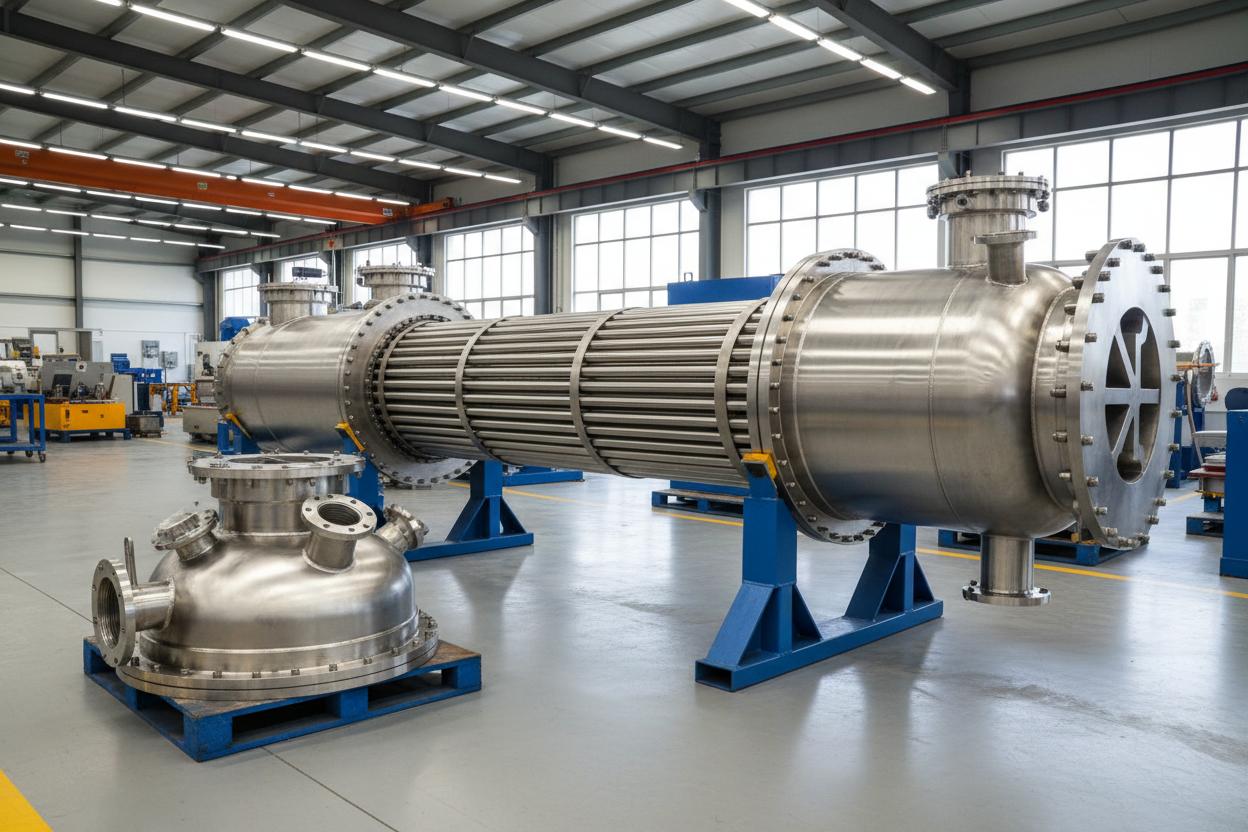
CFD-predicted temperature field on a plate heat exchanger
Heat exchangers are the workhorses of thermal energy management in water treatment plants, power stations, and process industries. Poor thermal design leads to fouling, excessive pressure drop, suboptimal heat transfer, and premature failure. Reynolds & Bauhm's CFD thermal simulation reveals temperature fields, wall shear stress distributions, and fouling-prone regions that rule-of-thumb design cannot predict.
Our conjugate heat transfer models couple hot and cold streams through solid walls with temperature-dependent viscosity, conductivity, and density. We simulate plate heat exchangers, shell-and-tube units, spiral exchangers, and bespoke welded designs to validate manufacturer performance curves and identify upgrade opportunities.
Chevron angle and corrugation depth optimisation for dairy pasteurisation, CIP heating, and boiler feed preheat. Predict pressure drop versus heat transfer trade-off curves.
Baffle spacing, tube layout, and shell-side bypass stream analysis for high-pressure process heating and cooling applications in chemical and petrochemical plants.
Self-cleaning spiral channel flow analysis for fouling services such as sludge heating, effluent preheat, and viscous fluid processing.
Natural convection and nucleate boiling analysis for tank heating coils in process vessels and storage tanks.
Fan performance and bundle row-by-row temperature analysis for cooling tower bypass and remote site applications.
Custom block-welded and all-welded plate exchangers for aggressive chemistries where gasketed designs cannot be used.
| Overall Heat Transfer Coefficient (U) | 2,000 – 6,000 W/m²K (water-water, plate HX) |
| Pressure Drop (Hot Side) | 20 – 100 kPa (design dependent) |
| Pressure Drop (Cold Side) | 15 – 80 kPa (design dependent) |
| Approach Temperature | 2 – 5°C (tight approach plate designs) |
| Fouling Factor | 0.0001 – 0.0004 m²K/W (water service) |
| Design Margin | 10 – 15% excess area for fouling allowance |
| Wall Thickness | 0.5 – 1.2 mm (SS316L plates) |
| Max Operating Pressure | 16 – 25 bar (standard plate packs) |
CAD models from manufacturer or bespoke design imported and prepared for CFD meshing with feature capture.
Hex-dominant or polyhedral mesh with boundary layer refinement. Y+ < 1 on all heat transfer surfaces.
Conjugate heat transfer with temperature-dependent properties, turbulence model selection, and heat flux boundary conditions.
Steady-state and transient runs with mesh independence verification. Validation against NTU-effectiveness method.
Design of Experiments (DoE) on plate spacing, corrugation angle, and port diameter for maximum effectiveness.
Temperature contour plots, velocity vectors, heat flux maps, and performance summary with upgrade recommendations.
External and internal forced convection with turbulent boundary layers, entrance effects, and developing flow regions accurately captured using low-Reynolds turbulence models.
Buoyancy-driven flow from density variations with Boussinesq and full compressible formulations for high Rayleigh number applications including solar heating and passive cooling.
Nucleate pool boiling, flow boiling, and film condensation with heat transfer coefficient correlations validated against Rohsenow and Nusselt analytical solutions.
Surface-to-surface radiation and participating media radiation for high-temperature dryers, furnaces, and combustion applications with view factor calculation.
Heat transfer through packed beds, filter media, and insulation with effective thermal conductivity and non-thermal equilibrium between fluid and solid phases.
Electrical resistance heating in immersed heaters, trace heating, and electrocoagulation cells with coupled electrical potential and energy equations.
Every CFD thermal simulation undergoes rigorous validation before design recommendations are issued. We correlate model predictions against analytical solutions, established empirical correlations, and field measurement data from commissioned installations. Our validation protocol ensures that thermal predictions are accurate to within ±5% for outlet temperatures, ±10% for heat transfer coefficients, and ±15% for transient thermal response times.
Laminar pipe flow Graetz solution, flat plate Blasius thermal boundary layer, and sphere Nusselt number correlation agreement.
Dittus-Boelter, Gnielinski, and Petukhov correlations for turbulent tube flow within ±8% agreement across Reynolds range.
Over 50 commissioned installations with measured outlet temperatures, heat duties, and mixing times for model calibration.
External and internal forced convection with turbulent boundary layers, entrance effects, and developing flow regions accurately captured using low-Reynolds turbulence models.
Buoyancy-driven flow from density variations with Boussinesq and full compressible formulations for high Rayleigh number applications including solar heating and passive cooling.
Nucleate pool boiling, flow boiling, and film condensation with heat transfer coefficient correlations validated against Rohsenow and Nusselt analytical solutions.
Surface-to-surface radiation and participating media radiation for high-temperature dryers, furnaces, and combustion applications with view factor calculation.
Heat transfer through packed beds, filter media, and insulation with effective thermal conductivity and non-thermal equilibrium between fluid and solid phases.
Joule heating in immersed heaters, trace heating cables, and electrocoagulation cells with coupled electrical potential and energy equations.
Every CFD thermal simulation undergoes rigorous validation before design recommendations are issued. We correlate model predictions against analytical solutions, established empirical correlations, and field measurement data from commissioned installations. Our validation protocol ensures thermal predictions are accurate to within ±5% for outlet temperatures, ±10% for heat transfer coefficients, and ±15% for transient thermal response times.
Laminar pipe flow Graetz solution, flat plate Blasius thermal boundary layer, and sphere Nusselt number correlation agreement.
Dittus-Boelter, Gnielinski, and Petukhov correlations for turbulent tube flow within ±8% agreement across Reynolds range.
Over 50 commissioned installations with measured outlet temperatures, heat duties, and mixing times for model calibration.
CFD thermal simulation identifies hotspots, thermal gradients, and inefficiencies before capital is committed. Speak with our thermal simulation engineers to model your heat transfer challenge.
Our expertise spans multiple industries with sector-specific water treatment solutions.