
CFD thermal simulation for commercial avionics, civil UAV payloads, satellite onboard equipment, and ground-support electronics. Model altitude convection derating, conduction-cooled interfaces, solar radiation, and orbital eclipse transients.
CFD thermal simulation services for water treatment equipment.
CFD thermal simulation for LED lighting enclosures and heat sinks.
CFD thermal mixing simulation for tanks, reactors, and process vessels.
CFD thermal simulation for LiDAR enclosures. Predict laser diode temperature, prevent optical window condensation, and validate.
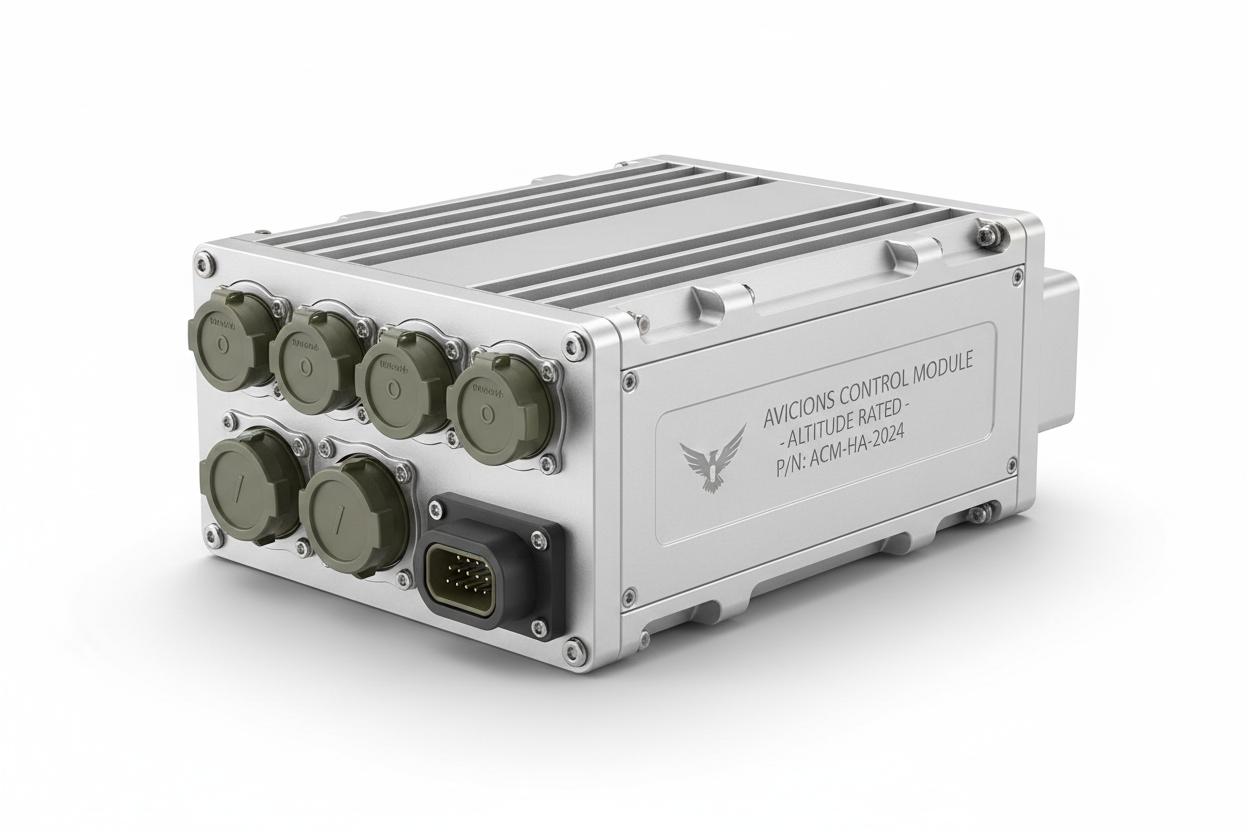
CFD temperature field in a conduction-cooled avionics LRU
Aerospace electronics operate in the most thermally challenging environment of any industry. At 10,000 metres altitude, air density is only 40% of sea level – reducing natural and forced convection by 60% and making fan cooling far less effective. Solar radiation above the clouds is 30% more intense than at sea level, creating extreme surface temperatures on sun-facing black enclosures. At night, radiative cooling to deep space at -270°C can plunge unprotected surfaces below -60°C. Satellites experience even more severe orbital cycles: 90-minute transitions from full solar exposure to total eclipse, causing thermal shock that cracks solder joints and delaminates PCBs.
Reynolds & Bauhm's aerospace enclosure CFD models account for altitude-dependent air properties, solar and albedo radiation, conduction-cooled chassis with cold plate interfaces, and phase-change thermal storage for transient peak loads. We design for commercial aviation (DO-160) and space (ECSS-E-ST-10-04C) environments with full traceability and documentation.
Line-replaceable units in ARINC 600 or ATR chassis with conduction cooling to cold plates. Model card-edge thermal interfaces, wedge-lock contact resistance, and altitude convection derating.
Compact, lightweight enclosures for ISR, SAR, and communication payloads. Model motor vibration, propeller downwash, and altitude effects on fan and natural convection performance.
Conduction and radiatively cooled enclosures in geostationary and LEO orbits. Model solar panel back-face heating, Earth albedo, and eclipse thermal shock with phase-change buffers.
Short-duration high-g and aerodynamic heating environments. Model transient ascent heating, cryogenic tank proximity, and staging shock thermal effects on guidance computers.
Mobile and fixed test equipment enclosures for airfield and hangar environments. Model solar loading, dust filtration, and transport vibration with thermal fatigue.
Discuss your specific requirements with our technical team and receive a tailored proposal for your project.
Contact Us| Operating Ambient (Avionics) | -55°C to +70°C (DO-160 Category) |
| Operating Ambient (UAV) | -40°C to +55°C (extended for desert operations) |
| Altitude Range | Sea level to 15,240 m (50,000 ft) for commercial aviation |
| Air Density at 10,000 m | 0.413 kg/m³ (41% of sea level) |
| Solar Constant (AM0) | 1,360 W/m² (space), 1,120 W/m² (sea level peak) |
| Conduction Cold Plate HTC | 200 – 500 W/m²K (wedge lock dependent) |
| Orbital Period (LEO) | 90 – 120 minutes (sun/eclipse cycle) |
| PCB In-Plane Conductivity | 10 – 30 W/mK (2-oz copper, fibre direction) |
A commercial aerial-survey operator developing a high-resolution mapping payload for a medium-altitude long-endurance UAV experienced FPGA overheating during summer operations at 6,000 m altitude. The payload enclosure was a sealed aluminium box (305×203×102 mm) with external longitudinal fins, mounted on the UAV fuselage underside. At sea level, natural convection kept the FPGA below its 85 °C case limit. At 6,000 m, however, air density dropped to 66% of sea level, natural convection decreased by 34%, and the FPGA case temperature reached 97 °C after 45 minutes of continuous on-board image processing — triggering thermal throttling that reduced effective map resolution by 40%. The UAV was forced to descend to 4,000 m during summer missions, sacrificing survey coverage. Reynolds & Bauhm conducted altitude-corrected CFD thermal simulation with ideal-gas density variation, temperature-dependent air viscosity, and radiation from the hot fins to the cold sky. The model showed that the longitudinal fin orientation aligned with airflow during forward flight was suboptimal — the forward fins created a wake that sheltered aft fins, reducing their effective convection by 50%. We recommended: (1) rotating the fin array 45° to intercept propeller slipstream from all approach angles, (2) applying black anodising to increase fin emissivity from 0.05 to 0.85 for radiative cooling dominance at altitude, and (3) adding a 5 W micro-blower inside the enclosure to force air across the FPGA heat sink base. Post-modification CFD predicted FPGA case temperature of 79 °C at 6,000 m in 35 °C ambient — an 18 °C improvement. Flight trials over 12 sorties confirmed no thermal throttling at 6,500 m, and on-board image resolution remained at full specification throughout 4-hour missions. The design was adopted for the operator’s production survey fleet.
Full mapping payload performance restored at 6,500 m, regaining 2,500 m of useful survey altitude.
On-board image resolution remained at full specification throughout 4-hour missions.
Design adopted across the operator’s production survey fleet with zero thermal incidents.
Enclosure, cold plate, PCB, and component CAD imported. Material properties defined for aluminium, titanium, copper, composites, and TIMs.
Ideal-gas density, viscosity, and thermal conductivity from ISA tables. Fan performance curves corrected for altitude derating.
Solar, albedo, and Earth infrared radiation for orbital and high-altitude cases. Surface optical properties and view factors calculated.
Wedge-lock, card-edge, and bolted joint thermal resistance modelled with contact pressure and surface roughness effects.
Orbital eclipse cycles, mission profiles, and intermittent radar/communication duty cycles modelled for phase-change buffer sizing.
Temperature reports, hotspot maps, margin analysis, and full design dossier for DO-160 or ECSS qualification.
Environmental conditions and test procedures for airborne equipment – temperature, altitude, vibration, and EMC for commercial aviation.
European Cooperation for Space Standardisation – space environment engineering with thermal vacuum, radiation, and outgassing requirements.
Quality management systems for aviation, space, and defence organisations with full traceability and configuration control.
UK Ministry of Defence environmental handbook for material and equipment testing in climatic and mechanical conditions.
Performance parameter classification for air-cooled avionics with thermal management requirements for conduction and convection cooling.
Discuss your specific requirements with our technical team and receive a tailored proposal for your project.
Contact UsCFD enclosure thermal simulation predicts internal temperatures, identifies hotspots, and validates cooling strategies before prototype fabrication. Speak with our thermal engineers to safeguard your electronics.
Our expertise spans multiple industries with sector-specific water treatment solutions.