
CFD thermal simulation for telecom cabinets, data centre edge nodes, industrial control panels, outdoor IoT gateways, and medical electronics. Optimise airflow, validate active and passive cooling, and prevent thermal shutdown before deployment.
CFD thermal simulation services for water treatment equipment.
CFD thermal simulation for LED lighting enclosures and heat sinks.
CFD thermal mixing simulation for tanks, reactors, and process vessels.
CFD thermal simulation for LiDAR enclosures. Predict laser diode temperature, prevent optical window condensation, and validate.
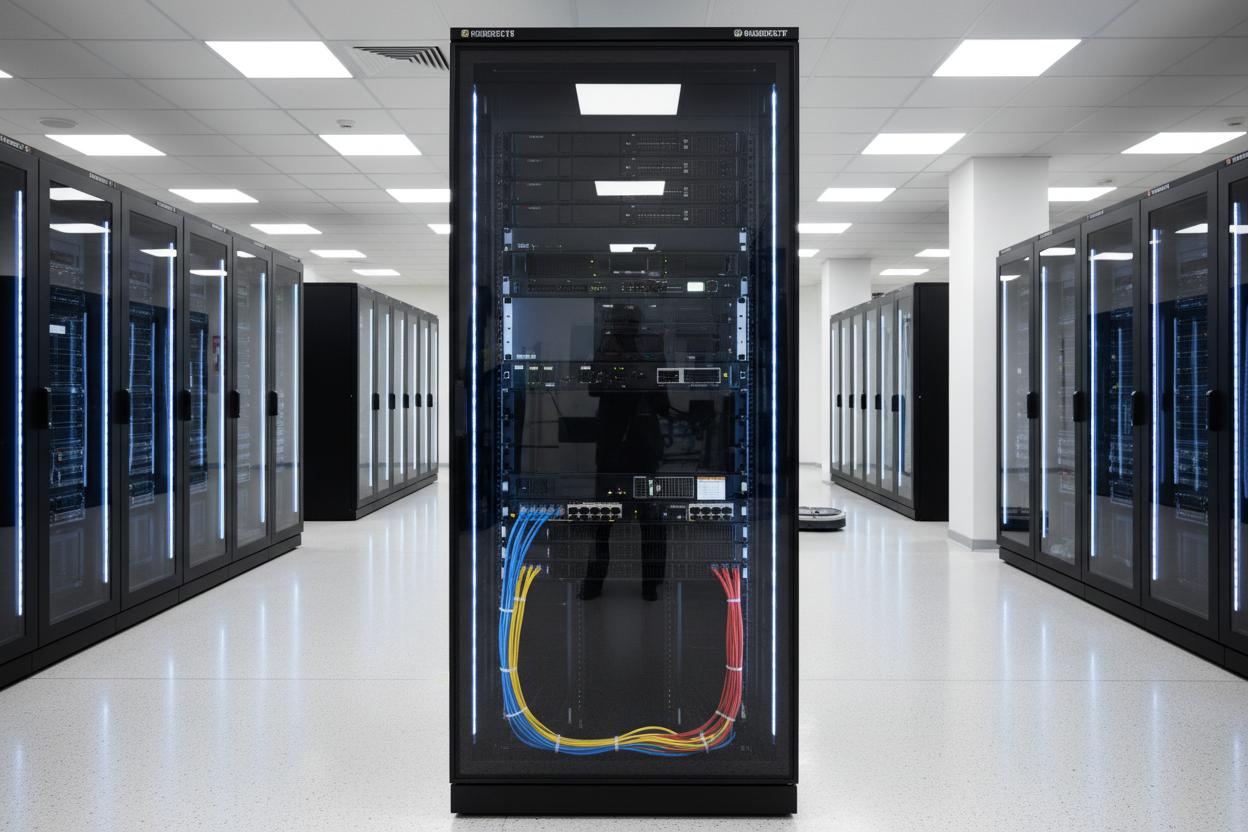
CFD airflow streamlines in a telecom cabinet with active cooling
Telecom cabinets, data centre edge nodes, industrial PLCs, outdoor IoT gateways, and medical electronics all share a common thermal challenge: reliable operation in enclosures that were often designed for aesthetics or security first, and thermal performance second. A typical 19-inch rack cabinet with 2 kW of server load can experience internal air temperatures 25°C above ambient if airflow is poorly managed – pushing silicon junctions into thermal throttling and reducing MTBF by 50%. For outdoor cabinets in direct sunlight, solar gain adds another 15-20°C, creating conditions that exceed the rated temperature of capacitors, hard drives, and power supplies.
Reynolds & Bauhm's general electronics enclosure CFD models simulate cabinet-level airflow from inlet to exhaust, server-level convection through heat sinks and card guides, and component-level junction temperature prediction. We optimise passive ventilation apertures, fan placement and ducting, filter selection for dust vs airflow trade-offs, and liquid cooling integration for high-density edge computing. Every design is validated against IEC 61587-1 (empty enclosures) and Telcordia GR-63 (network equipment) thermal requirements.
Outdoor BTS, DSLAM, and fibre node cabinets. Model passive ventilation, fan-forced cooling, heat exchangers, and air conditioning for tropical and desert cell towers.
Compact edge computing enclosures with 5-15 kW/m³ density. Model hot aisle/cold aisle, containment, liquid cooling manifolds, and free cooling economisers.
PLC, VFD, and HMI enclosures in factories and process plants. Model filter clogging, oil mist ingress, washdown protection, and hazardous area compliance.
Smart city and agriculture sensor hubs with solar/battery power. Model low-power passive cooling, solar panel shading, and rodent/pest intrusion thermal effects.
Patient monitors, imaging equipment, and diagnostic enclosures. Model fan noise constraints, sterilisation chemical exposure, and patient-proximity thermal comfort.
CCTV NVR, access control, and perimeter monitoring enclosures. Model tamper-proof sealing, pole-mounted solar loading, and Faraday cage thermal resistance.
| Cabinet Heat Load | 200W – 20kW (telecom to edge computing) |
| Internal Air Rise Target | <15°C above ambient (IEC 61587-1) |
| Rack Inlet Temperature | 18 – 27°C (ASHRAE recommended range) |
| Fan Airflow per kW | 80 – 150 m³/h/kW (temperature rise dependent) |
| Filter Pressure Drop | 20 – 100 Pa (clean to replacement threshold) |
| Heat Exchanger Capacity | 50 – 2,000W (sealed cabinet, closed loop) |
| Liquid Cooling Capacity | 10 – 100 kW/rack (high-density edge nodes) |
| Solar Load (Horizontal) | 1,000 W/m² peak (enclosure roof and walls) |
A European mobile network operator deployed 2,000 outdoor 5G base station cabinets in southern Europe where summer ambient temperatures regularly exceeded 40°C and solar loading on dark-grey cabinets added 18°C to internal air temperature. The cabinets contained 4 kW of radio and baseband equipment with manufacturer-specified maximum inlet air temperature of 45°C. The standard cabinet design relied on four 120 mm axial fans drawing air through bottom vents and exhausting at the top. During August heatwaves, internal temperatures reached 62°C, triggering radio unit thermal shutdown and 4G/5G service degradation across 340 sites. The operator faced regulatory fines for service availability below 99.9%. Reynolds & Bauhm performed cabinet-level CFD with full geometry, solar loading, fan curves, and filter pressure drop. The model identified severe airflow short-circuiting: hot exhaust air from the top vents was drawn back into the bottom intake due to the low mounting height (200 mm above ground) and lack of intake ducting. We recommended: (1) relocating intake vents to the cabinet rear with labyrinth baffles to prevent exhaust recirculation, (2) upgrading fans to higher-pressure 172 mm units with PWM speed control, (3) replacing the standard dust filter with a low-pressure-drop synthetic media, and (4) applying white solar-reflective paint to the cabinet roof to reduce solar gain by 15°C. Post-modification CFD predicted maximum internal temperature of 44°C at 43°C ambient with full solar load – within the 45°C equipment limit. The operator retrofitted 340 affected cabinets over three months. The following summer recorded zero thermal shutdowns, service availability improved to 99.97%, and avoided regulatory fines exceeded ±2.8M. Fan power consumption decreased 18% due to the lower pressure-drop filter and improved aerodynamic efficiency.
Internal temperature reduced from 62°C to 44°C under peak summer ambient and solar load.
Service availability improved from 99.2% to 99.97%, avoiding ±2.8M regulatory fines.
Fan power reduced 18% through improved aerodynamics and lower pressure-drop filtration.
Cabinet, rack, card guides, PCBs, and component CAD imported. Simplified representations preserve thermal-critical airflow paths.
Component-level power dissipation from datasheets and measured load profiles. Hotspots identified for priority cooling.
Inlet/exhaust vent sizing and placement, fan selection and ducting, filter specification, and baffle design to prevent short-circuiting.
Heat exchanger, air conditioner, or liquid cooling loop sizing. Refrigeration load calculation and condenser placement optimisation.
Diurnal and seasonal ambient variation, solar loading on painted surfaces, and wind-driven convection for outdoor cabinets.
Internal temperature maps, component junction tables, airflow streamlines, filter replacement intervals, and energy consumption estimates.
Empty enclosures for electrical and electronic equipment – mechanical and thermal performance tests for standardised dimensions.
Network Equipment-Building System requirements for telecom cabinets including thermal, seismic, and fire resistance.
Thermal guidelines for data processing environments – recommended and allowable inlet temperatures for IT equipment.
19-inch rack mechanical structures for electronic equipment – card dimensions, mounting, and thermal interfaces.
Quality management systems ensuring consistent design, manufacturing, and commissioning of electronic enclosures.
Restriction of hazardous substances and chemical registration for electronic enclosure materials and coatings.
CFD enclosure thermal simulation predicts internal temperatures, identifies hotspots, and validates cooling strategies before prototype fabrication. Speak with our thermal engineers to safeguard your electronics.
Our expertise spans multiple industries with sector-specific water treatment solutions.